

Bitcoin Mining Hosting Pricing: All-In vs Pass-Through and What Shows Up on Your Invoice
By Josh Heine, Content Strategist at Simple Mining
Updated April 1, 2026Published March 3, 2026
A hosting provider quotes you $0.07/kWh. You sign the contract. Your first invoice arrives at $0.085/kWh after demand charges, management fees, and a repair bill you did not expect.
Bitcoin mining hosting pricing determines whether your operation is profitable or bleeding capital. The gap between the advertised rate and the real number on your invoice is where most investors lose money. This guide breaks down the three pricing models, shows you every line item on a real hosting bill, and gives you the questions that reveal what a provider is hiding.
On this page · 9 sections
- How Bitcoin Mining Hosting Pricing Models Work
- What Shows Up on a Bitcoin Mining Hosting Invoice
- Nameplate Power vs Wall Draw: How Billing Basis Changes Your Cost
- How Uptime Credits and SLA Language Affect Your Bill
- How to Compare Hosting Quotes on True Cost
- How Hosting Pricing Affects Your Break-Even Bitcoin Price
- How Simple Mining Hosting Pricing Works
- FAQs
- Know Your Invoice Before You Sign
Key Takeaways
- Bitcoin mining hosting pricing comes in three models: all-in (single bundled rate), pass-through (base rate plus itemized fees), and hybrid. The model determines what appears on your invoice.
- A typical hosting invoice includes 4–7 line items beyond base electricity: demand charges, transmission fees, management fees, setup costs, and repair charges.
- Nameplate vs wall-draw billing can shift your effective cost by 3–6%. Get your provider's billing basis in writing before signing.
- Precision billing (pay only for actual uptime) protects you from paying for power during repairs and downtime. Flat-rate billing charges the full month regardless.
- Compare providers by calculating effective $/kWh after all fees and uptime adjustments. The cheapest headline rate often produces the highest total cost.
How Bitcoin Mining Hosting Pricing Models Work
Hosting pricing falls into three structures: all-in, pass-through, and hybrid. The model determines what appears on your invoice and how your costs shift month to month.
Understanding which model your provider uses is the first step to calculating your true cost of mining.
All-In Pricing
An all-in rate bundles electricity, management, monitoring, security, and infrastructure fees into a single $/kWh number. What you see is what you pay. This model simplifies budgeting because your cost per kilowatt-hour stays predictable.
The trade-off: all-in rates may be slightly higher than a bare-bones electricity quote. But they eliminate invoice surprises. You can model profitability with one number instead of guessing at five.
Pass-Through Pricing
Pass-through models quote a base electricity rate and then add separate line items for each additional cost. Demand charges, transmission fees, management fees, and maintenance get invoiced individually.
This model looks cheaper on paper. The base rate might be $0.05/kWh. But once you add the pass-throughs, you could land at $0.08 to $0.10/kWh. The transparency can be useful if you read every line. It can also obscure total cost if you focus on the headline number.
Hybrid Structures
Some providers bundle certain costs (electricity plus infrastructure) while passing through others (repairs, curtailment credits). Hybrid models require careful contract review. Ask for a sample invoice before signing so you can see the actual line items.
What Shows Up on a Bitcoin Mining Hosting Invoice
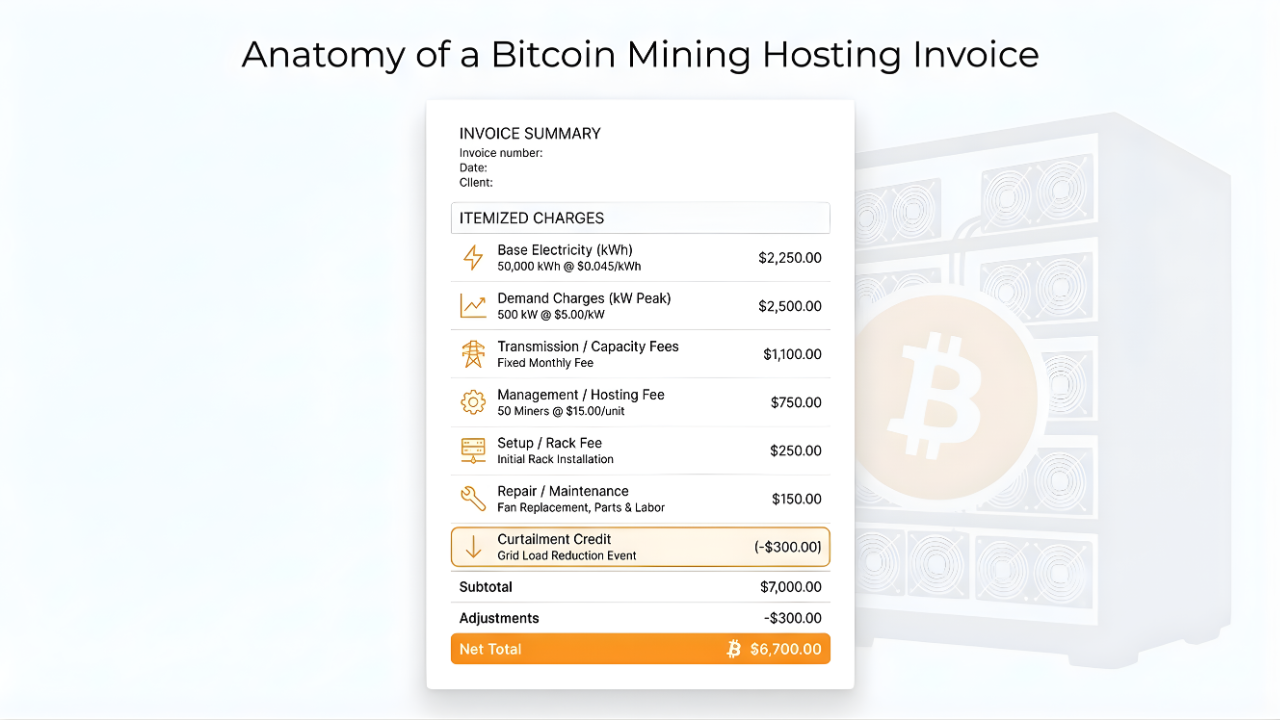
A typical hosting invoice contains four to seven line items beyond the base electricity charge. Knowing each one helps you spot padding and compare providers on equal footing.
| Line Item | What It Covers | Typical Range |
|---|---|---|
| Base electricity | Raw power consumption (kWh) | $0.04–$0.07/kWh |
| Demand charges | Peak power draw fee (kW-based) | $0.01–$0.03/kWh effective |
| Transmission/capacity | Grid infrastructure pass-throughs | $0.005–$0.02/kWh effective |
| Management fee | Monitoring, security, support | Flat monthly or bundled |
| Rack/setup fee | One-time deployment charge | $0–$150 per miner |
| Repair/maintenance | Parts and labor for failures | Per-incident or included |
| Curtailment credit | Refund for forced downtime | Varies by provider |
Some providers roll demand charges and transmission fees into a single "facilities" line. Others break them out. The labels change. The costs do not.
Operator reality: We see invoices from clients who switched to Simple Mining after discovering $0.02–$0.03/kWh in pass-through fees their previous provider never disclosed during the sales process. That spread on a 10-miner fleet adds up to hundreds of dollars per month.
Nameplate Power vs Wall Draw: How Billing Basis Changes Your Cost
The gap between nameplate and wall-draw billing can shift your effective rate by 3–6%. This is one of the most overlooked details in a hosting contract.
Nameplate power is the wattage printed on the manufacturer spec sheet. Wall draw is the actual power consumption measured at the outlet. Most ASICs pull 3–6% more power than nameplate.
An Antminer S21 XP lists a nameplate of 3,645 watts. Wall draw on many units runs closer to 3,800–3,850 watts. If your provider bills on wall draw at $0.075/kWh, your monthly cost is roughly $208. If they bill on nameplate at the same rate, your cost drops to about $197. That $11/month difference is an effective discount you earn just by choosing the right billing basis.
Ask your provider directly: do you bill nameplate or wall draw? Get the answer in writing.
How Uptime Credits and SLA Language Affect Your Bill
An SLA defines what happens to your bill when your miner goes offline. Without one, you have no contractual recourse for downtime losses.
Precision Billing vs Flat-Rate Billing
Precision billing charges you only for the time your miner is hashing and producing revenue. If your machine goes down for a three-day repair, you pay nothing for those three days.
Flat-rate billing charges a fixed monthly amount regardless of downtime. Your miner could sit powered off for a week and you still owe the full invoice.
| Billing Model | You Pay For | Your Risk |
|---|---|---|
| Precision billing | Actual uptime only | Lower |
| Flat rate | Full month regardless | Higher |
Operator reality: A single hashboard failure can take a miner offline for days. Under flat-rate billing, that failure costs you twice: lost mining revenue plus full power charges. Under precision billing, you only lose the revenue.
What to Look for in SLA Fine Print
Read these sections before signing any hosting contract:
- Uptime guarantee percentage. Providers with high uptime back it with a formal SLA. Those who do not publish a number often have something to hide.
- Exclusions. Some SLAs exclude "scheduled maintenance" or "force majeure" from uptime calculations. These carve-outs can erase the guarantee.
- Credit mechanism. Does the SLA provide credits for missed uptime? How are credits calculated? Are they automatic or do you have to file a claim?
- Repair turnaround commitment. An SLA without a repair timeline is incomplete. A provider with on-site repair capabilities can restore hashrate in days. A provider who ships machines to an off-site shop may take weeks.
How to Compare Hosting Quotes on True Cost
Strip every quote down to the same unit: effective cost per kWh after all fees, credits, and uptime adjustments. This is the only number that produces an accurate comparison.
Step 1: Request a sample invoice or full fee schedule from each provider. If they refuse, move on.
Step 2: Add every line item to get total monthly cost for the same miner model.
Step 3: Divide total monthly cost by expected kWh consumed (adjusted for their uptime guarantee).
Step 4: Compare that effective rate across providers.
Red flags to watch for:
- A quoted rate that does not include demand charges or pass-through fees
- No published uptime guarantee or SLA
- Minimum commitment periods longer than 12 months with no exit option
- Repair costs quoted "per incident" with no price list for common parts
- No mention of curtailment policy or forced-downtime credits
A provider charging $0.075/kWh all-in with 98% uptime and included repairs often costs less per Bitcoin produced than a provider at $0.065/kWh with 92% uptime and $300 repair bills. Run the math on your specific hardware before choosing.
How Hosting Pricing Affects Your Break-Even Bitcoin Price
Your break-even BTC price rises dollar-for-dollar with your effective hosting rate. A $0.01/kWh increase does not sound like much until you multiply it across 2,000+ kWh per month per miner.
The formula:
Break-Even BTC Price = Total Monthly Hosting Costs ÷ Total Monthly BTC Mined
If your all-in hosting cost is $200/month and your miner produces 0.004 BTC/month, your break-even is $50,000. Bump that hosting cost to $220/month with the same output and your break-even jumps to $55,000. Our tracker runs the electricity side of the same math and publishes the break-even $/kWh and cost per Bitcoin for each miner model, before hosting fees and hardware.
That $5,000 swing in break-even changes how much cushion you have against price drops and difficulty increases. Run scenarios at your actual effective rate using a mining calculator before committing capital.
How Simple Mining Hosting Pricing Works
Simple Mining uses true all-in pricing. The rate covers power, 24/7 monitoring, security, cooling, and standard support with no hidden add-on fees.
Rates are tiered by total operational capacity:
| Tier | Capacity | All-In Rate |
|---|---|---|
| Starter | 0–499 kW | $0.08/kWh |
| Premium | 500–999 kW | $0.075/kWh |
| Enterprise | 1,000+ kW | $0.07/kWh |
Nameplate billing. Simple Mining bills on the manufacturer's stated wattage rather than actual wall draw. Most ASICs pull 2–5% more power than nameplate under real conditions. An Antminer S21 rated at 3,500W often runs closer to 3,700W. You get billed for the 3,500W. That gap gives you an automatic ~5.5% discount on electricity costs.
Precision billing. You pay for exact metered uptime. If your machine goes offline for repairs or any other reason, you stop paying for power. No flat monthly charges regardless of performance. This keeps Simple Mining's incentives aligned with keeping your machines hashing.
Pause periods. Mining profitability fluctuates with hashprice and network difficulty. Simple Mining's Pause Period feature lets you power down machines during unprofitable conditions without breaking your contract or facing penalties. You stop paying for power entirely until conditions improve. This converts fixed electricity costs into variable costs and acts as built-in downside protection.
On-site repairs. Simple Mining operates one of the largest Bitmain-certified ASIC repair centers in North America at its Cedar Falls, Iowa facility. Full-time technicians perform board-level diagnostics and repairs in-house. Average turnaround runs days to weeks rather than the 4–8 weeks typical for manufacturer returns. All hosted miners purchased through Simple Mining include 12 months of repair coverage. That removes a major unpredictable maintenance line item from your first-year cost model.
FAQs
What is an all-in hosting rate in bitcoin mining?
An all-in rate bundles electricity, management, monitoring, and infrastructure costs into a single $/kWh price. You pay one rate with no additional line items. This makes budgeting and profitability modeling straightforward.
Does precision billing save money compared to flat-rate billing?
Yes. Precision billing charges only for actual hashing uptime. During repairs or downtime events, you stop paying for power. Flat-rate billing charges the full month regardless of whether your miner was online.
How do demand charges appear on a hosting invoice?
Demand charges are based on peak power draw (measured in kW) rather than total consumption (kWh). They appear as a separate line item on pass-through invoices. On all-in invoices, they are absorbed into the single rate.
Know Your Invoice Before You Sign
The cheapest advertised rate and the lowest total cost are almost never the same thing. Your profitability depends on what shows up on the actual invoice, not the number on a sales page.
Request a sample invoice. Ask about billing basis. Read the SLA. Then run the numbers with your real effective rate.