

Bitcoin Mining Containers: Costs, Setup, and Whether You Need One
By Josh Heine, Content Strategist at Simple Mining
Published August 7, 2026
A Bitcoin mining container is a shipping container converted into a modular data center for ASIC miners. It is one line item inside a self-hosted build, not an alternative to hosting: the enclosure you buy after you have land, power, and an interconnect. As of August 2026 a fitted 40-foot air-cooled unit runs $40,000 to $70,000 before a single miner goes in, and the power behind it can take years to secure.
On this page · 8 sections
- What Is a Bitcoin Mining Container?
- How Much Does a Bitcoin Mining Container Cost?
- How to Set Up a Bitcoin Mining Container
- Power and Cooling Requirements for Mining Containers
- Pros and Cons of Bitcoin Mining Containers
- Mining Container vs. Hosted Deployment
- FAQs About Bitcoin Mining Containers
- How to Decide if a Mining Container Is Right for You
Key Takeaways
- A mining container is the enclosure inside a self-hosted build, purchased after land, power, and an interconnect are secured.
- As of August 2026, 20-foot air units start near $15,000, 40-foot air units run $40,000 to $70,000, and hydro and immersion builds run $112,000 to $300,000 before miners.
- Capacity runs about 100 to 250 units in a 20-foot air container, 250 to 600 in a 40-foot, and 240 or 420 slots in hydro.
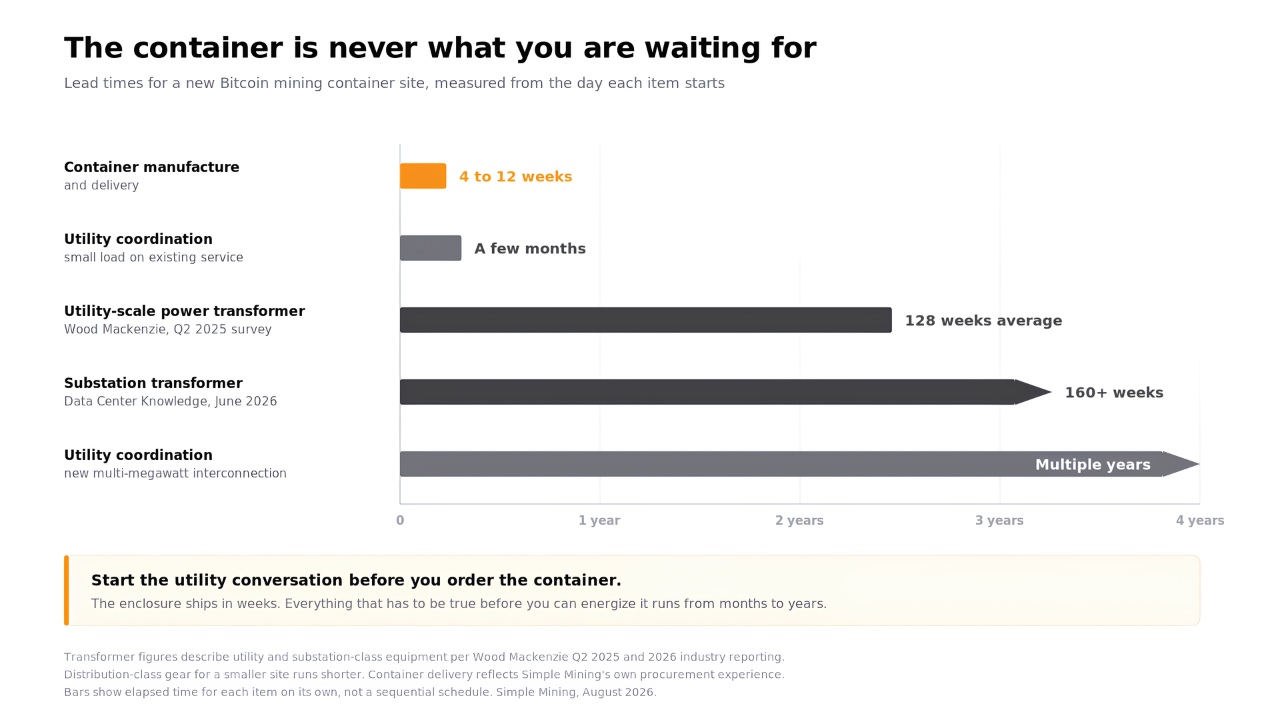
- The enclosure ships in 4 to 12 weeks, while utility coordination runs from months to years and transformers can gate the schedule.
- Below about 5 MW of controlled power, hosted deployment beats a container build on speed and capital.
What Is a Bitcoin Mining Container?
A Bitcoin mining container is a steel shipping container rebuilt as a mobile, modular data center for ASIC miners. The unit arrives with power distribution, cooling, racks, and monitoring installed, so the miners inside need only utility power and a network. It is one line item inside a self-hosted build: the purchase that comes after the land, the power contract, and the interconnect exist.
Standard sizes are 20-foot and 40-foot ISO containers, with 45-foot high-cube units in some lines. Five components define the category: a steel enclosure, pre-wired PDUs, cooling matched to the hardware, ventilation and filtration, and remote monitoring.
Capacity is a range, never a single number: cooling type and miner generation set it, and the FAQ below carries the bands. Design quality moves those numbers too: the jump from 96 to more than 300 miners per container came when Simple Mining retired its self-built enclosures, per the 2025 Giga Energy case study. Fleet size sets expected yield, and how long it takes to mine one Bitcoin comes down to the fleet's share of network hashrate.
How Much Does a Bitcoin Mining Container Cost?
A Bitcoin mining container costs from about $15,000 for a small air-cooled unit to more than $300,000 for a 40-foot immersion build, before miners, electrical infrastructure, or site work. Configuration and cooling type drive the spread more than container size does. The bands below carry vendor listings as of August 2026, each with its source and date.
| Configuration | Price band | Source and date |
|---|---|---|
| 20-foot air-cooled | From about $15,000 | Conexwest, live August 2026 |
| 20-foot air-cooled | $20,000 to $40,000 | Petahashminer, October 2025 |
| 40-foot air-cooled | $40,000 to $70,000 | Petahashminer, October 2025 |
| 40-foot air-cooled, 396 to 432 slots fitted | $126,900 to $145,000 | bitcoinminingcontainer.com, May 2025 |
| Multi-MW 40-foot builds | Upwards of $200,000 | OBM/Foreman, September 2025 |
| Fog Hashing HC40-M1200, 1.2 MW hydro | $112,100 to $118,000 | Apexto, July 2025 |
| 40-foot immersion | $120,000 to $300,000 | Petahashminer, October 2025 |
Larger hydro units price by quote: the 2.4 MW Fog Hashing containers carry no published list price.
Infrastructure-Complete vs. Custom Fit-Out
An infrastructure-complete container is what most vendors call turnkey: PDUs, cooling, racks, and monitoring installed and ready for miners. No vendor prices a miner-loaded container: hardware is its own line item, sometimes bundled as a separate quote. Budget the two together, since filling a 40-foot unit from the current-generation ASIC miners for sale in our inventory adds a hardware bill several times the container price. Custom fit-outs start from a modified enclosure and add electrical and cooling to the buyer's spec.
Used and Refurbished Containers
A secondary market runs through fabricators and brokers, trading upfront capital for shorter warranties: Conexwest backs new mining containers for 10 years and refurbished builds for 5. Inspect fans, pumps, coolant loops, and electrical before purchase. A cheap enclosure with a tired cooling loop is not cheap.
Hidden Costs Most Buyers Overlook
Beyond the container price you carry site prep, transformers, switchgear, interconnection fees, permits, transportation, crane time, and ongoing maintenance, all sized in our state-by-state siting breakdown.
How to Set Up a Bitcoin Mining Container
Setting up a mining container runs through five steps, and power is the long pole in every one of them. The enclosure ships in weeks, so the site work sets the real schedule.
1. Select a Site With Adequate Power Access
Cheap electricity drives container placement. Proximity to a substation or industrial service lowers interconnection cost. Rural or industrial zoning is the norm, since neighbors hear an air-cooled unit before they see it: check local limits against the decibels those fans push past the fence before committing to the site.
2. Secure Permits and Zoning Approval
An electrical permit is required almost everywhere in the US, then zoning or land use approval. The environmental layer depends on the site, and the permits FAQ below lists the full stack from stormwater to state-level regimes.
3. Install Electrical Infrastructure
Switchgear sits between utility service and the PDUs to protect, isolate, and distribute power. Utility coordination runs from a few months for small loads on existing service to multiple years for new multi-megawatt interconnections, and long-lead equipment like transformers can gate the schedule regardless of approval speed. Standard power transformers averaged 128-week lead times in Wood Mackenzie's Q2 2025 survey, and Data Center Knowledge reported substation transformer lead times above 160 weeks in 2026.
4. Position and Connect the Container
A flatbed delivers the unit, and a crane sets it on a concrete pad or gravel base. Orientation matters for air-cooled units: intake and exhaust should work with prevailing wind, and adjacent containers need spacing that keeps one unit's exhaust out of the next unit's intake. That hot-air recirculation is the siting mistake crews catch most often.
5. Configure Miners and Monitoring
The final step is network and fleet configuration: internet service, pool and wallet credentials on every unit, and dashboard access for hashrate and temperature monitoring.
Power and Cooling Requirements for Mining Containers
Every mining container manages the same two constraints: delivering megawatt-scale power to dense racks and rejecting the heat those racks produce. Air, hydro, and immersion are the three families of data center cooling, and containers ship in all three.
Electrical Load and Transformer Sizing
Total power draw is miner count times per-unit wattage, and the transformer above the container must carry that continuous load with margin. Three-phase power is standard for commercial containers, and current hydro hardware specs 380 to 480 volt input. Inadequate cooling cuts hashrate through thermal throttling. Sustained heat then shortens hardware life and drives hashboard failures.
Air-Cooled Container Systems
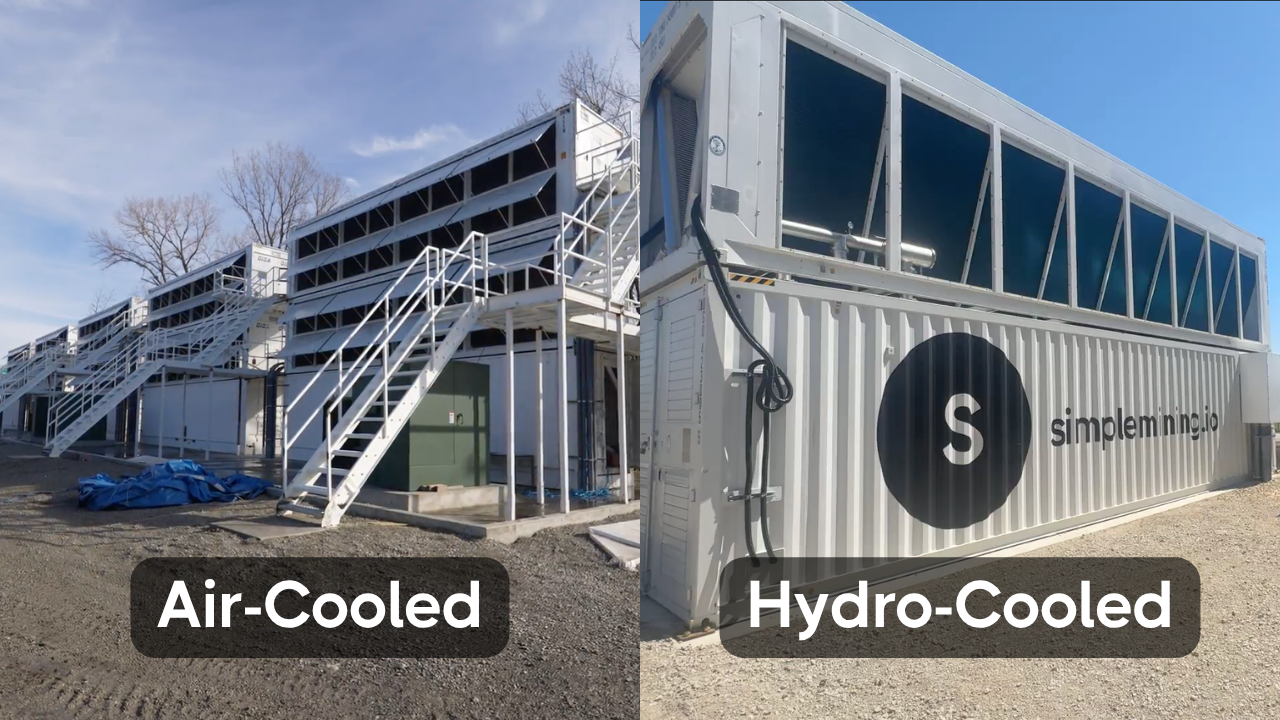
Air-cooled containers move outside air across the fleet through a fan wall and louvers. The fan wall concentrates exhaust on one face, and the louvers sit on the intake side with filtration behind them. Air is the lowest-cost entry, and its limits are ambient temperature against the miner's rated ceiling and fan noise. Simple Mining runs Giga Energy air-cooled containers across its Iowa sites.
[IMAGE 2]
Hydro-Cooled Container Systems
Hydro cooling is direct-to-chip liquid cooling: coolant circulates through cold plates mounted on the hashboards in a closed loop, and dry coolers reject the heat outside the container. A closed-loop glycol system uses no evaporative water. Hydro is not a subtype of immersion: the miners are sealed factory units and the container is plumbing, pumps, and heat rejection.
Two hardware ecosystems define hydro containers. The Antminer ecosystem runs shoebox units such as the S23 Hydro, the S21 Hydro, and the S19 Hydro family, plus the 3U rack U3S21EXPH and U3S23H. The Fog Hashing HC40-S2400 serves it with 420 shoebox slots at 2.4 MW, and the HC45-S1200 racks 90 Antminer 3U and 2U units at 1.2 MW in a 45-foot container. The 2U server ecosystem covers WhatsMiner M-series hydro, SealMiner A-series hydro, and the Auradine Teraflux AH3880. The Fog Hashing HC40-M2400 is a 40-foot hydro container rated at 2.4 MW that racks 240 2U hydro miners, and the Fog Hashing H2400-M Cluster is a skid-based warehouse system rated at 2.4 MW that supports 240 2U hydro miners.
SealMiner hydro units use the same 2U rack format as WhatsMiner hydro miners, while SealMiner air-cooled units are conventional fan-cooled box miners. Fog Hashing validates 2U hydro units from MicroBT, Bitdeer, and Auradine in the same rack slots. New vendors building to the 2U hydro form factor tend to rack into the same slots once validated, which keeps the fleet upgrade path open without container changes.
The two densities differ by design, so never average them: a 2U system runs about 10 kW per slot and a shoebox Antminer system about 5.7 kW, reaching the same 2.4 MW through 240 slots or 420. Simple Mining runs Fog Hashing hydro containers alongside its air-cooled fleet. Hydro cooling leads our expansion, with 2U hydro leading within that. That statement describes our capacity planning and cooling architecture, not a ranking of manufacturers.
Immersion-Cooled Container Systems
Immersion cooling submerges miners in dielectric fluid, a non-conductive liquid that pulls heat off every component. The payoff is thermal headroom and quiet operation, and immersion can extend hardware life by eliminating dust intrusion, fan failures, and thermal cycling. The costs are price, fluid handling, and maintenance skill. The split between immersion and factory hydro miners decides whether you convert air units into tanks or buy sealed liquid-cooled machines.
Pros and Cons of Bitcoin Mining Containers
A container's advantages are physical: it moves, it stacks, and it stands on gravel where a building takes a year.
Advantages of Container Mining
- Portability. The unit relocates by flatbed when power pricing changes.
- No building required. A pad, a transformer, and an interconnect replace a construction project.
- Stackability. Standard and high-cube enclosures stack, so a tight site scales upward.
- Speed of the enclosure. Manufactured units ship in weeks.
- Self-contained design. Power distribution, cooling, and monitoring arrive as one engineered unit.
Disadvantages and Risks to Consider
- Cooling-type lock-in. A container built for shoebox hydro slots takes no 2U hardware and the reverse holds, so the enclosure choice constrains every future fleet decision.
- Fixed capacity per unit. Growth past the slot count means another container, not a rack.
- Owner-carried maintenance. Every failed fan, pump, and hashboard is the owner's diagnostic problem and parts bill, while hosted fleets lean on in-house ASIC repair with free repair labor instead of a shipping label and a distant queue.
- Secondary-market friction. Used containers sell at a discount to replacement cost to a thin buyer pool.
Mining Container vs. Hosted Deployment
A container purchase suits operators who control cheap power and accept the build timeline. Hosted deployment suits everyone who wants hashrate sooner than an interconnect allows. A new container site takes months to a year or more to energize, or weeks where power exists on site. A hosted miner starts in days once hardware arrives at the facility.
A build carries the container, the electrical infrastructure, and the site, while a managed mining hosting service reduces the purchase to the miners and moves the site risk, the cooling design, and the maintenance queue onto the host. Our state-by-state siting breakdown owns the full build-versus-rent decision.
FAQs About Bitcoin Mining Containers
How many ASIC miners fit inside a standard shipping container?
A 20-foot air-cooled container holds about 100 to 250 miners and a 40-foot air-cooled container holds about 250 to 600, depending on miner generation and rack design. A 40-foot hydro container racks 240 units in 2U systems or 420 slots in shoebox Antminer systems. Immersion and hydro containers hold fewer discrete units in some layouts but run far more power per slot. Total hashrate per container often ends up higher as a result.
What permits do you need to install a Bitcoin mining container?
An electrical permit, a zoning or land use approval, and a utility interconnection agreement form the baseline for a container install. Site conditions add environmental layers: stormwater permits for ground disturbance, air permits where generators or flare-gas engines run, and spill prevention plans for glycol or diesel storage. Local noise ordinances apply on top of all of it, and state regimes such as New York's moratorium on certain fossil-fueled proof-of-work operations can restrict the project outright.
Can mining containers support AI servers?
They are not interchangeable. Mining containers and AI data center halls solve overlapping power and cooling problems, but AI racks demand redundant power, low-latency networking, and tighter environmental control than an ASIC enclosure provides. Simple Mining hosts Bitcoin miners in Iowa and is separately developing power-ready AI data center capacity at US sites, and the two are distinct products for that reason.
What is the typical lifespan of a Bitcoin mining container?
The steel enclosure lasts decades with maintenance, and the cooling and electrical systems inside it are the components that age. The ASIC miners run three to five years before newer generations and rising difficulty push them out of profit, so plan on refreshing the fleet twice or more within one enclosure's life.
Can you finance a Bitcoin mining container purchase?
Yes. Some manufacturers and vendors offer financing, and third-party equipment lenders write loans against container purchases. Terms track creditworthiness, configuration, and the lender's view of hardware resale value, so quotes vary more than the container prices do.
How to Decide if a Mining Container Is Right for You
Buy a container when you control below-market power at 5 MW or more of load, and host below that line. That threshold comes from our breakdown of site capex and state-by-state siting, since staff, permits, and interconnection costs amortize across megawatts. Four questions settle it:
- Do you control cheap power? A container only makes sense where the power contract beats what a host offers all-in.
- Can you carry the capital? The enclosure, the transformer, and the site work all spend before the first satoshi arrives.
- Do you have the staff? Someone diagnoses the 2 a.m. hashboard failure, and on a self-hosted site that someone is you.
- Does the math clear? Run your all-in cost per coin under both paths before committing capital.
If the numbers point away from the build, Simple Mining hosts client hardware across 150+ MW and over 4 EH/s in Iowa on Giga Energy air-cooled and Fog Hashing hydro platforms, with all-in hosting from $0.07 to $0.08 per kWh and 95%+ average uptime. Skip the interconnection queue and move your fleet into Bitcoin miner hosting in Iowa.