

Antminer S21 XP Hydro Review: Specs, Efficiency & ROI (2026)
By Josh Heine, Content Strategist at Simple Mining
Updated September 23, 2026Published April 10, 2026
The Antminer S21 XP Hydro packs 473 TH/s into a liquid-cooled chassis at 12 J/TH. Those numbers put it in the top tier of current-gen SHA-256 hardware. The hydro cooling system trades fan noise for plumbing complexity, and that trade-off shapes every deployment decision.
This review covers specs, operating costs, break-even math, and head-to-head comparisons against the S21e XP Hydro, S21+ Hydro, and S23 Hydro.
On this page · 10 sections
- What Is the Antminer S21 XP Hydro?
- How Efficient Is the S21 XP Hydro Compared to Other Miners?
- What Power and Infrastructure Does the S21 XP Hydro Need?
- How Long Does It Take to Break Even on the S21 XP Hydro?
- How Does the S21 XP Hydro Compare to Alternatives?
- Who Should Buy the S21 XP Hydro?
- Should You Host or Self-Mine the S21 XP Hydro?
- Buying the S21 XP Hydro Through Simple Mining
- Frequently Asked Questions
- The Efficiency Sweet Spot
Key Takeaways
- The Antminer S21 XP Hydro delivers 473 TH/s at 12 J/TH, making it the second most efficient SHA-256 hydro miner behind the S23 Hydro (9.5 J/TH).
- At $0.07/kWh, this machine needs a hashprice above ~$20.17/PH/day to operate profitably.
- Three-phase 380–415V power and a coolant distribution unit (CDU) are non-negotiable. This is not a plug-and-play home miner.
- Compared to the S21e XP Hydro (430 TH/s, 13 J/TH), the S21 XP Hydro produces 10% more hashrate at 8% better efficiency for a $500 premium.
- Best suited for investors deploying capital into hosted mining who want proven efficiency without the S23 Hydro's hefty price tag.
- Simple Mining carries this model with hosted deployment, 12 months of repair coverage, precision billing, and a pause period for downside protection.
What Is the Antminer S21 XP Hydro?
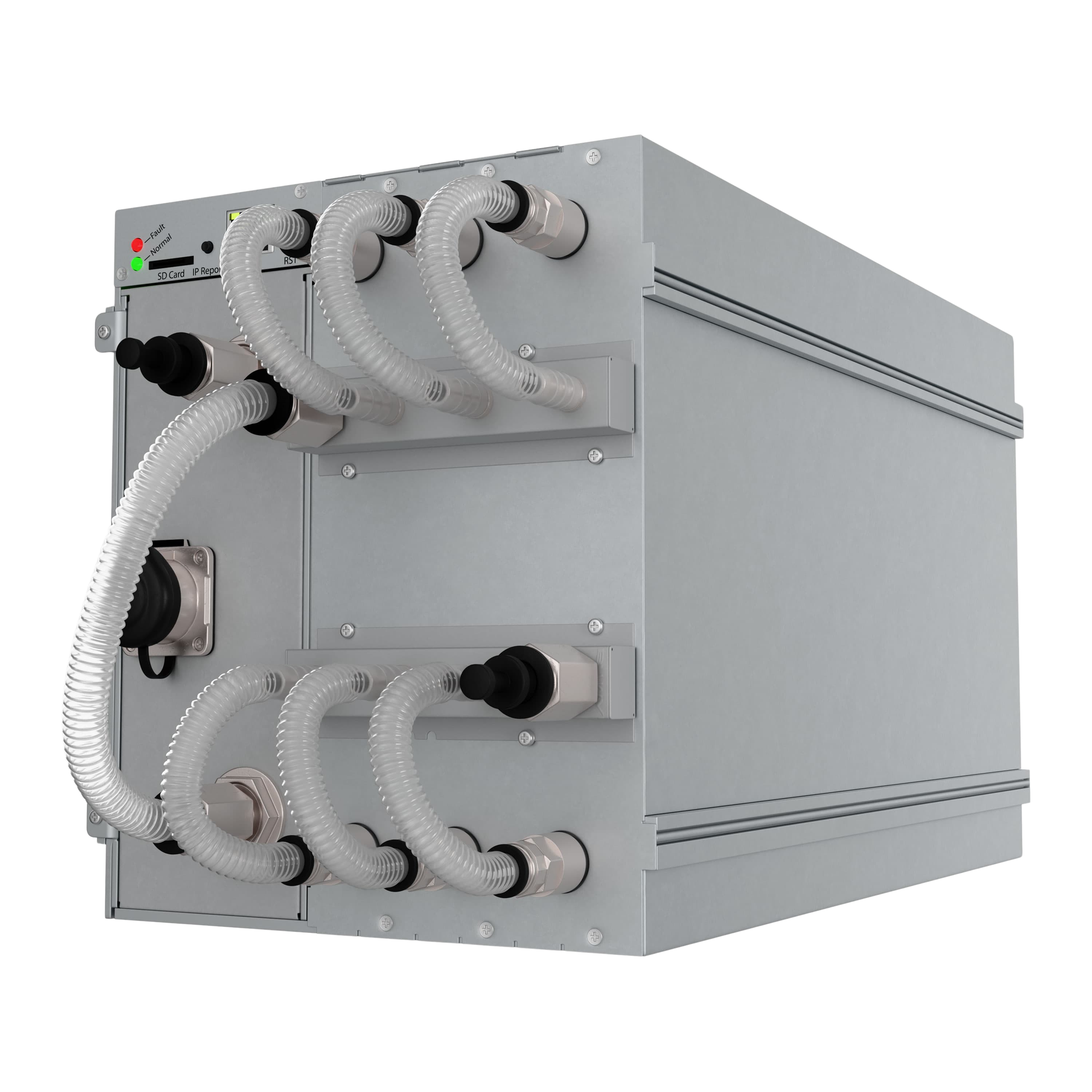
The Antminer S21 XP Hydro is a 473 TH/s hydro-cooled Bitcoin miner built by Bitmain for the SHA-256 algorithm. It shipped in late 2024 as the high-performance counterpart to the air-cooled S21 XP (270 TH/s). The hydro cooling system removes heat through liquid rather than fans, which allows Bitmain to pack more hashing power into a smaller chassis at 12 J/TH.
That 12 J/TH positions it ahead of the S21e XP Hydro (13 J/TH) and well ahead of the S21+ Hydro family (15 J/TH). The only current-gen miner with better efficiency is the S23 Hydro at 9.5 J/TH, which costs about 75% more.
Core Specifications at a Glance
| Spec | Value |
|---|---|
| Hashrate | 473 TH/s (±3%) |
| Power Consumption | 5,676W (±5%) |
| Efficiency | 12 J/TH |
| Algorithm | SHA-256 |
| Cooling | Hydro (liquid) |
| Input Voltage | 380–415V AC (three-phase) |
| Operating Temperature | 5–45°C |
| Noise Level | ~50 dB (verify against Bitmain spec sheet) |
| Dimensions | 339 × 173 × 207 mm |
| Weight | ~12.8 kg |
| Manufacturer | Bitmain |
| Release | Q4 2024 |
The ±3% hashrate tolerance means real output ranges from 459 to 487 TH/s. The ±5% power tolerance means wall draw could reach ~5,960W. Plan your circuits for the upper end. At Simple Mining, precision billing charges at nameplate rather than wall draw, giving you a built-in margin on electricity costs.
How Efficient Is the S21 XP Hydro Compared to Other Miners?
At 12 J/TH, the S21 XP Hydro ranks second among current-gen hydro miners. A 1 J/TH difference compounds across every hour of operation. The S21 XP Hydro uses ~8% less electricity per terahash than the S21e XP Hydro. Over a full year that translates to meaningful savings and a wider margin of safety when hashprice compresses.
Electricity Cost at Common Rates
The S21 XP Hydro consumes 136.22 kWh per day (5.676 kW × 24 hours). Those daily kilowatt-hours are also what set this machine's electricity-only cost to produce one Bitcoin, which our live tracker breaks out by model and power rate.
Formula: Daily cost = (watts ÷ 1,000) × 24 × $/kWh
| Electricity Rate | Daily Cost | Monthly Cost (30 days) |
|---|---|---|
| $0.065/kWh | $8.85 | $265.64 |
| $0.07/kWh | $9.54 | $286.07 |
| $0.075/kWh | $10.22 | $306.50 |
| $0.08/kWh | $10.90 | $326.94 |
| $0.10/kWh | $13.62 | $408.67 |
| $0.12/kWh | $16.35 | $490.41 |
Simple Mining's all-in hosting rates run $0.065–$0.08/kWh depending on fleet size. Use the Simple Mining calculator to model your exact scenario with live data.
What Hashprice Does the S21 XP Hydro Need to Break Even?
Break-even hashprice is the minimum revenue per petahash per day needed to cover electricity. The S21 XP Hydro produces 0.473 PH/s.
Formula: Break-even hashprice = Daily electricity cost ÷ petahashes
| Electricity Rate | Break-Even Hashprice |
|---|---|
| $0.065/kWh | ~$18.71/PH/day |
| $0.08/kWh | ~$23.04/PH/day |
| $0.12/kWh | ~$34.57/PH/day |
Check live Bitcoin mining stats for current conditions. As long as hashprice stays above your threshold, the machine generates positive cash flow before accounting for the purchase price.
What Power and Infrastructure Does the S21 XP Hydro Need?
The S21 XP Hydro requires three-phase 380–415V AC power. Standard residential circuits cannot run this machine. At 5,676W nameplate (up to ~5,960W actual), each unit needs a dedicated circuit sized for the ±5% tolerance. Monthly consumption runs about 4,087 kWh per unit.
The machine operates at about 50 dB, comparable to a refrigerator. By contrast the air-cooled S21 XP runs at 76 dB. Heat output reaches ~19,370 BTU/h per unit, all managed through the hydro cooling loop.
The hydro system requires a CDU with adequate heat rejection capacity, manufacturer-specified coolant, rated plumbing, and leak detection at every fitting. Coolant loop maintenance is one of the most overlooked failure points in hydro mining. Corrosion and fitting leaks can take a machine offline with no warning.
How Long Does It Take to Break Even on the S21 XP Hydro?
Break-even timing = purchase price ÷ monthly net profit. The catch: net profit is not static. Difficulty adjustments and Bitcoin price swings move the target. Model at least three scenarios (stable conditions, 3% monthly difficulty growth, and 5% growth) before committing capital. Factor 95–98% uptime instead of 100%.
Use our Bitcoin mining calculator to run scenarios with live data. For a deeper look at ROI math, see the mining rig costs and ROI guide.
How Does the S21 XP Hydro Compare to Alternatives?
| Model | Hashrate | Power | Efficiency | Cooling | Last listed price |
|---|---|---|---|---|---|
| S21+ Hydro (395 TH) | 395 TH/s | 5,925W | 15 J/TH | Hydro | $7,000 |
| S21e XP Hydro (430 TH) | 430 TH/s | 5,590W | 13 J/TH | Hydro | $8,000 |
| S21 XP Hydro (473 TH) | 473 TH/s | 5,676W | 12 J/TH | Hydro | $8,500 |
| S23 Hydro (563 TH) | 563 TH/s | 5,349W | 9.5 J/TH | Hydro | $15,000 |
S21 XP Hydro vs S21e XP Hydro
The S21e XP Hydro delivers 430 TH/s at 13 J/TH and was last listed at $8,000. The S21 XP Hydro offers 10% more hashrate and 8% better efficiency and was last listed at $8,500. Both are now quoted per order, and a current quote may come in lower. The efficiency gain pays for itself through lower electricity costs per terahash over the machine's life. The S21e draws a bit less total power (5,590W vs 5,676W), which could matter at scale if facility capacity is tight.
S21 XP Hydro vs S21+ Hydro (395 TH)
The S21+ Hydro 395 runs at 15 J/TH and was last listed at $7,000. It uses more power (5,925W) for less hashrate (395 TH/s). The S21 XP Hydro is 20% more efficient and produces 20% more hashrate. At $0.08/kWh the S21+ Hydro 395 costs ~$0.48 more per day in electricity while producing 78 fewer terahashes. The S21+ Hydro makes sense when the lowest possible upfront cost is the priority.
S21 XP Hydro vs S23 Hydro
The S23 Hydro is the flagship at 563 TH/s and 9.5 J/TH. It costs $15,000, about 75% more than the S21 XP Hydro. At $0.08/kWh the S23 Hydro saves about $0.63/day in electricity while producing 90 more terahashes. For a $6,500 premium the payback on that efficiency gap alone takes years. Choose the S23 for maximum lifespan. Choose the S21 XP Hydro for strong efficiency at a more accessible price.
Who Should Buy the S21 XP Hydro?
Buy if:
- You want the best efficiency-per-dollar among current hydro miners and plan to hold for 2+ years.
- You have access to hosted mining at $0.08/kWh or below.
- Your budget sits in the $8,000–$9,000 range and you want to maximize hashrate and efficiency within that band.
Skip if:
- You need the lowest upfront cost. The S21+ Hydro 395 TH at $7,000 saves $1,500 per unit.
- You want to self-mine at home. This machine requires three-phase power and a hydro cooling loop.
- You can afford $15,000 per unit and prioritize maximum lifespan via the S23 Hydro's 9.5 J/TH.
Should You Host or Self-Mine the S21 XP Hydro?
Most buyers should host. Three-phase 380–415V power is not available in standard homes. The hydro loop needs a CDU and plumbing plus ongoing coolant management. Self-mining can work in a commercial facility with the right electrical service and cooling capacity.
At Simple Mining, hosted machines receive repair coverage for 12 months and precision billing at nameplate wattage. The pause period feature lets you stop hashing during unprofitable conditions without breaking your contract or paying electricity. If your all-in rate is $0.065–$0.08/kWh, hosting is the straightforward choice.
Buying the S21 XP Hydro Through Simple Mining
The Antminer S21 XP Hydro is in stock at Simple Mining. Visit the product page for current pricing.
Purchasing and hosting through Simple Mining includes $0.065–$0.08/kWh all-in power (tiered by fleet size), 12 months of repair coverage at one of the largest Bitmain-certified ASIC repair centers in North America, precision billing on actual hashing time, and access to the Simple Mining dashboard. After the initial 12-month term the optional Protection Plan covers ongoing repairs at $3.99–$5.99/mo per machine. Pool flexibility lets you mine to any pool with discounted fees through partnerships with Luxor, NiceHash, and Ocean.
For a broader look at how to buy Bitcoin mining hardware, see the buyer's checklist.
Frequently Asked Questions
What hashrate does the Antminer S21 XP Hydro deliver?
The S21 XP Hydro produces 473 TH/s at nameplate. Bitmain's ±3% tolerance means real-world output ranges from about 459 to 487 TH/s. Most units settle near or just above the rated 473 TH/s figure after an initial burn-in period.
Can I mine Bitcoin at home with the S21 XP Hydro?
No, for most homes. The S21 XP Hydro requires three-phase 380–415V AC power and a hydro cooling loop with a CDU. Standard residential electrical service does not support this configuration.
What electricity rate makes the S21 XP Hydro profitable?
At rates below $0.08/kWh, the S21 XP Hydro operates with a comfortable margin under most hashprice conditions. The break-even hashprice at $0.07/kWh is ~$20.17/PH/day. At $0.10/kWh margins tighten and profitability depends on hashprice staying elevated.
Is the S21 XP Hydro better than the S21e XP Hydro?
For most buyers, yes. The S21 XP Hydro delivers 10% more hashrate at 8% better efficiency for a $500 premium. The S21e XP Hydro wins only on lower total wattage (5,590W vs 5,676W) and a $500 lower price point.
What repair coverage comes with the S21 XP Hydro?
Machines purchased and hosted through Simple Mining include 12 months of repair coverage (free repair labor, unlimited fan replacements and a $500 annual parts allowance). After the initial term, the Simple Mining Protection Plan covers ongoing repairs at $3.99–$5.99/month per machine depending on fleet size. The plan includes free repair labor, unlimited fan replacements and a $500 annual parts allowance, and any unused allowance can go toward a replacement if a unit can't be repaired.
Is the S21 XP Hydro worth it in 2026?
It depends on your electricity rate and time horizon. At hosted rates of $0.065–$0.08/kWh the S21 XP Hydro remains well above break-even under current conditions. Its 12 J/TH efficiency provides a wider margin of safety against future difficulty increases than less efficient alternatives.
The Efficiency Sweet Spot
The Antminer S21 XP Hydro occupies the middle ground where strong efficiency meets accessible pricing. For most hosted mining investors, that is where the best risk-adjusted returns live.
View the S21 XP Hydro on Simple Mining → | Schedule a call →