

What is Bitcoin?
By Josh Heine, Content Strategist at Simple Mining
Updated September 22, 2026Published May 28, 2024
Bitcoin is a decentralized digital currency that operates without a central bank or administrator. It allows people to send money to each other over the internet, with every transaction recorded on a public ledger called the blockchain.
Since its launch in 2009, Bitcoin has grown from a niche experiment into a global asset class held by individuals, corporations, and even nation-states. This guide covers how Bitcoin works, where it gets its value, and the different ways to acquire it.
Key Takeaways
- Bitcoin (BTC) is the first decentralized digital currency. It operates on a peer-to-peer network without banks or governments, with every transaction recorded on a public blockchain.
- Only 21 million Bitcoin will ever exist. The halving schedule cuts new supply roughly every four years, making Bitcoin scarcer over time.
- Mining is how new Bitcoin enters circulation. Specialized ASIC hardware competes to verify transactions and earn block rewards, securing the network through proof-of-work.
- Bitcoin functions as money, a store of value, and an investment asset. It enables borderless payments, is held by individuals and institutions, and is accessible through exchanges and ETPs.
- Hosted mining offers a hands-off way to accumulate BTC. Services like Simple Mining provide lower electricity costs, on-site repairs, and professional infrastructure so investors can mine without managing hardware.
What is Bitcoin and What Does BTC Mean?
Bitcoin (BTC) is the first decentralized digital currency. It operates on a peer-to-peer network without a central bank or administrator. Introduced in 2008, Bitcoin allows users to send money to each other online without intermediaries. Every transaction gets recorded on a public, permanent ledger called the blockchain.
The ticker symbol BTC represents Bitcoin on exchanges and financial platforms, similar to how USD represents the US dollar. You'll also see the symbol ₿ used in some contexts.
What makes Bitcoin different from traditional money? No single entity controls it. The network runs on thousands of computers worldwide. No government or bank can manipulate the supply, freeze accounts, or reverse transactions.
- Decentralized: No government, bank, or company controls the network.
- Digital: Bitcoin exists only online with no physical coins.
- Peer-to-peer: Users send value to each other without banks.
- Immutable: Once recorded, transactions cannot be changed or deleted.
Who Created Bitcoin?
A person or group using the name Satoshi Nakamoto published the Bitcoin whitepaper in October 2008. The network launched in January 2009 when Satoshi mined the first block, known as the "genesis block."
Satoshi's true identity remains unknown. After communicating with early developers through forums and email for a few years, Satoshi disappeared from public view in 2011.
The mystery doesn't affect how Bitcoin works. The code is open-source, meaning anyone can review, verify, and contribute to it.
How Does Bitcoin Work?
Bitcoin combines several technologies to create a system where value moves digitally without relying on a central authority. The three core components are the blockchain, transactions, and wallets.
Blockchain Technology
The blockchain is a distributed public ledger that records every Bitcoin transaction ever made. Think of it as a shared spreadsheet that thousands of computers around the world maintain at the same time.
Each "block" contains a batch of recent transactions. Once verified, that block links to the previous one, forming a chain. Changing past records would require altering every block that came after, across thousands of computers simultaneously.
Computers running Bitcoin software are called "nodes." Nodes verify transactions and maintain copies of the entire blockchain. This distributed structure means no single point of failure exists.
Bitcoin Transactions
When you send Bitcoin, your transaction broadcasts to the network. Nodes check that you own the Bitcoin you're sending and that you haven't spent it elsewhere.
- Initiate the transaction: Specify the recipient's address and the amount.
- Broadcast to the network: Your transaction spreads to nodes for verification.
- Confirmation: Miners add the transaction to a block, making it permanent.
A "confirmation" happens when your transaction gets included in a block. Most recipients wait for multiple confirmations before considering a transaction final.
Bitcoin Wallets
A Bitcoin wallet stores your private keys, not actual coins. Your Bitcoin always lives on the blockchain. The wallet holds the cryptographic keys that prove ownership.
Your public key works like an email address. You share it with others so they can send you Bitcoin. Your private key functions like a password. Whoever controls it controls the Bitcoin.
Wallets come in two main forms. Hot wallets stay connected to the internet for convenience. Cold wallets remain offline for maximum security. Many Bitcoin holders use both: a hot wallet for everyday transactions and cold storage for long-term holdings.
What is Bitcoin Mining?
Mining is the process that secures the Bitcoin network and creates new coins. Miners use specialized computers to verify transactions and compete to add new blocks to the blockchain.
Mining serves two purposes. First, it prevents fraud by making the network extremely expensive to attack. Second, it distributes new Bitcoin according to a predictable schedule.
Our full guide on what Bitcoin mining is covers the process in greater detail.
How Mining Secures the Network
Bitcoin uses a system called proof-of-work. Miners compete to solve complex mathematical puzzles, and the first to find a valid solution gets to add the next block.
The puzzles require enormous computational effort but are easy for others to verify. A miner might try trillions of combinations before finding one that works. This "hashing" process makes it prohibitively expensive for bad actors to manipulate the blockchain.
Difficulty adjusts automatically every two weeks. If miners solve blocks too fast, the difficulty increases. If they solve them too slowly, it decreases. This keeps new blocks appearing roughly every 10 minutes regardless of how much computing power joins the network.
Mining Hardware and Hashrate
Hashrate measures the computational power used to mine Bitcoin, expressed in terahashes per second (TH/s). One terahash equals one trillion hash attempts per second.
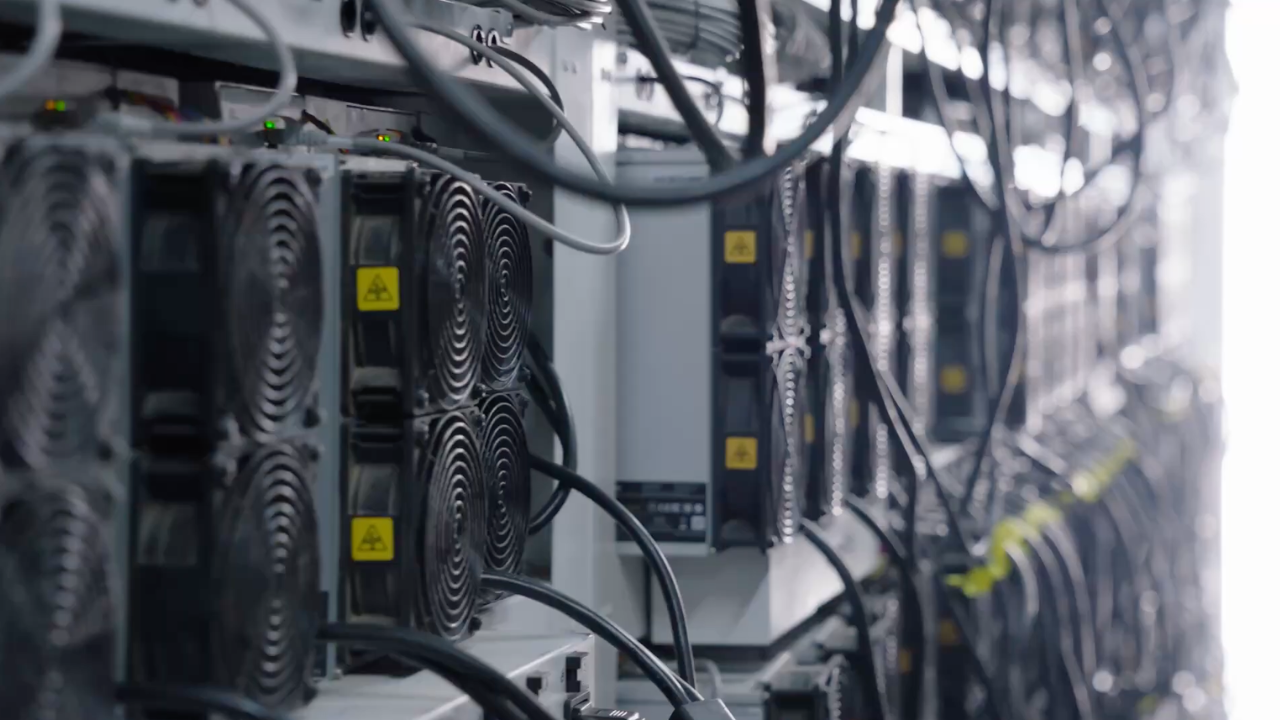
Early Bitcoin miners used regular computers. Then graphics cards. Today, only specialized machines called ASICs (Application-Specific Integrated Circuits) can mine profitably. ASICs do one thing (mine Bitcoin) but they do it extraordinarily well.
Professional miners host equipment in data centers rather than running machines at home. Data centers offer lower electricity costs, proper cooling, and around-the-clock maintenance. Hosting providers like Simple Mining manage power, repairs, and uptime so miners can focus on returns rather than operations.
Mining Rewards and the Halving
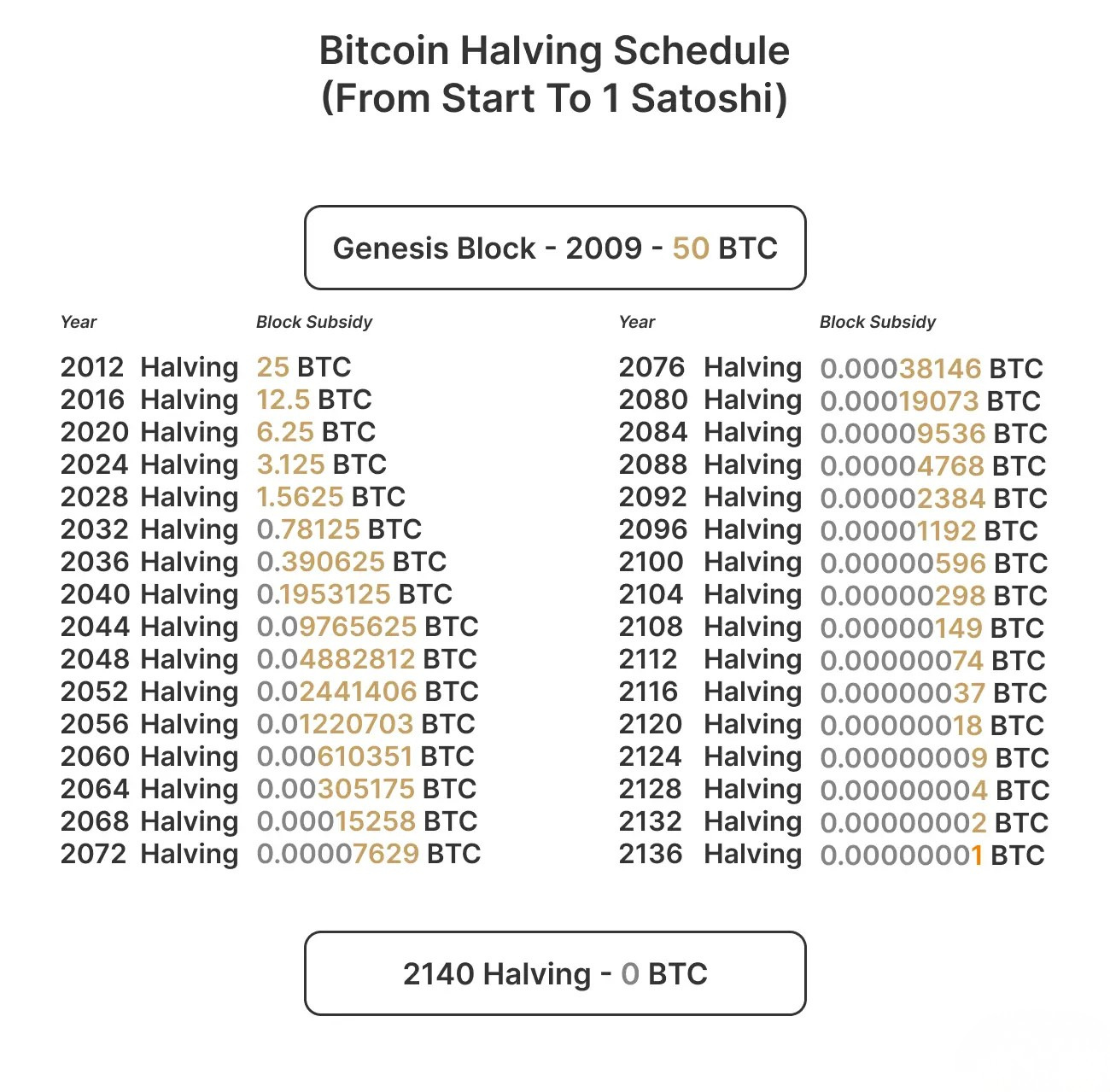
Miners earn newly created Bitcoin as rewards for adding blocks. When Bitcoin launched, the reward was 50 BTC per block. Today it's 3.125 BTC.
The "halving" is an event coded into Bitcoin's protocol that cuts the mining reward in half approximately every four years (every 210,000 blocks). This predictable reduction in new supply is central to Bitcoin's economic design.
| Halving Event | Year | Block Reward |
|---|---|---|
| Launch | 2009 | 50 BTC |
| 1st Halving | 2012 | 25 BTC |
| 2nd Halving | 2016 | 12.5 BTC |
| 3rd Halving | 2020 | 6.25 BTC |
| 4th Halving | 2024 | 3.125 BTC |
Eventually, around the year 2140, all 21 million Bitcoin will have been mined. After that, miners will earn only transaction fees. For a deeper look at how the halving affects mining economics, read our guide on Bitcoin mining profitability.
How to Get Bitcoin
Several paths exist for acquiring Bitcoin. Each involves different tradeoffs around convenience, cost, and control.
Buying Bitcoin on an Exchange
Exchanges are platforms where you can purchase Bitcoin with traditional currency like US dollars. The process involves creating an account, verifying your identity, linking a payment method, and placing an order.
You don't need to buy a whole Bitcoin. Exchanges let you purchase fractional amounts, sometimes as little as $1 worth.
Mining Bitcoin
Mining offers a different approach. Instead of buying Bitcoin at market price, you produce it using specialized hardware. Your cost basis becomes your electricity and equipment expenses rather than the exchange rate.
Most individual miners now use hosting services rather than running equipment at home. Professional hosting provides lower electricity rates, proper cooling, and expert maintenance. These factors significantly impact profitability over time.
Mining also offers potential tax advantages through equipment depreciation that aren't available when buying Bitcoin on an exchange.
Receiving Bitcoin as Payment
Bitcoin can be received as payment for goods, services, or person-to-person transfers. You share your wallet address with the sender, and no special account or approval is needed.
Some businesses accept Bitcoin directly. Others use payment processors that convert Bitcoin to local currency instantly. For freelancers and international workers, Bitcoin offers a way to receive payments without traditional banking infrastructure.
What Are Bitcoins Used For?
Bitcoin serves multiple purposes depending on who's using it and why. The most common use cases have evolved since Bitcoin's early days.
Digital Payments
Bitcoin enables borderless payments without intermediaries. You can send value to anyone with a Bitcoin address, anywhere in the world, at any time.
International transfers that take days through traditional banking can settle in minutes. Transaction fees depend on network congestion rather than the amount sent. Moving $10 or $10 million costs roughly the same.
Store of Value
Bitcoin is often called "digital gold" because of its scarcity and resistance to manipulation. With a fixed supply cap and no central authority that can print more, some view it as a hedge against currency devaluation.
The comparison isn't perfect. Bitcoin is far more volatile than gold over short timeframes. Over longer periods, however, Bitcoin has outperformed most traditional assets in purchasing power preservation. This is not investment advice.
Investment Asset
Bitcoin trades on exchanges worldwide. Individuals, corporations, and institutional investors hold it. Public companies have added Bitcoin to their balance sheets. The largest corporate holder is Strategy, the company formerly named MicroStrategy.
The introduction of spot Bitcoin ETFs in January 2024 made exposure accessible through traditional brokerage accounts. Investors can now gain Bitcoin exposure without managing wallets or private keys.
Why Bitcoin Has Value
A purely digital asset commanding value comes down to its fundamental properties. Bitcoin's worth stems from characteristics that traditional currencies and even gold cannot fully replicate.
Scarcity and the 21 Million Supply Cap
There will only ever be 21 million Bitcoin. This hard cap is coded into the protocol and cannot be changed without consensus from the entire network.
Central banks can print currency without a hard limit. Bitcoin's supply schedule is fixed and predictable. As of March 2026, roughly 20 million Bitcoin have been mined. An estimated 20% of all existing Bitcoin may be permanently lost due to forgotten private keys.
Decentralization and Network Security
No single entity can control, censor, or shut down Bitcoin. The network operates across thousands of nodes in dozens of countries.
The cost to attack Bitcoin (measured by the electricity and hardware required to overpower honest miners) runs into billions of dollars. This security comes from proof-of-work mining, which converts real-world energy into network protection.
Global Adoption and Network Effect
Bitcoin's utility increases as more people use and accept it. Each new user, merchant, or institution that adopts Bitcoin strengthens the network.
Major financial institutions now offer Bitcoin custody and trading. In March 2025, a U.S. executive order established a strategic Bitcoin reserve at the federal level. Multiple U.S. states have followed. Growing adoption creates a self-reinforcing cycle of legitimacy and liquidity.
Bitcoin vs Traditional Money
Bitcoin differs from traditional money in control, supply, transaction speed, availability, and transparency.
| Feature | Bitcoin | Traditional Money |
|---|---|---|
| Control | Decentralized network | Central banks and governments |
| Supply | Fixed at 21 million | Can be printed without limit |
| Transactions | Peer-to-peer, borderless | Requires intermediaries |
| Operating Hours | 24/7/365 | Banking hours, business days |
| Transparency | Public blockchain | Opaque banking systems |
| Seizure Risk | Controlled by private keys | Can be frozen by authorities |
Neither system is universally "better." Traditional banking offers consumer protections, reversible transactions, and familiar interfaces. Bitcoin offers sovereignty, censorship resistance, and a predictable monetary policy.
Getting Started with Bitcoin Today
Sound money should be hard to produce and impossible to fake. Bitcoin checks both boxes.
Buying Bitcoin on an exchange is the simplest way to get started. For those who want more than price exposure, mining offers a productive path to accumulate BTC. Hosting services make it accessible without managing hardware yourself.
Start your free 7-day mining trial with Simple Mining →
FAQs About Bitcoin
How much is one Bitcoin worth in US dollars?
Bitcoin's price fluctuates constantly based on supply and demand across global exchanges. You can check the current price on any cryptocurrency exchange, financial news site, or by searching "Bitcoin price" in your browser.
Is Bitcoin legal to own and use?
Bitcoin is legal in most countries, including the United States, Canada, the United Kingdom, and most of Europe. Regulations vary by jurisdiction. Some countries restrict certain activities like mining or operating exchanges. Always check local laws.
Can Bitcoin be converted to cash?
Yes. You can sell Bitcoin on an exchange for traditional currency, then withdraw those funds to a bank account. The process typically takes one to five business days depending on the exchange and your bank.
How long does it take to mine one Bitcoin?
At September 2026 conditions, one top-tier ASIC takes about 10 years to mine a whole Bitcoin solo, a mid-tier unit about 21 years, and an older unit about 41 years, while a commercial farm reaches a full coin in days. That's why most miners join pools, earning fractional rewards proportional to their contributed hashrate. See the full breakdown of how long it takes to mine 1 Bitcoin by setup.
Do you have to pay taxes on Bitcoin?
In most jurisdictions, including the United States, Bitcoin is treated as property for tax purposes. Selling Bitcoin for more than you paid triggers capital gains tax, and if you're sitting on a loss you can sell to harvest that loss and offset other gains. Mining income is typically taxed as ordinary income at the time you receive it. Consult a tax professional familiar with cryptocurrency for guidance specific to your situation.