

Bonus Depreciation for Bitcoin Mining: 2026 Complete Guide
By Josh Heine, Content Strategist at Simple Mining
Updated November 9, 2026Published July 19, 2024
Bonus depreciation for Bitcoin mining is a federal tax rule that lets miners deduct 100% of qualifying ASIC and infrastructure costs in the year the equipment is placed in service, rather than spreading the deduction across MACRS's five-year recovery schedule. The One Big Beautiful Bill (OBBB) restored this treatment permanently for property acquired after January 19, 2025, and that treatment carries into tax year 2026. Bitcoin miners running a real trade or business can deduct the full purchase price of qualifying ASICs in the year they're installed and hashing. That single deduction can wipe out mining income, slash self-employment tax, and in some cases offset W-2 wages, up to the excess business loss limit ($256,000 single, $512,000 joint for 2026). The catch is that "real trade or business" carries a heavy IRS test, and the rules around passive activity, material participation, and entity structure decide whether the deduction sticks.
On this page · 12 sections
- What Is Bonus Depreciation for Bitcoin Mining?
- How the One Big Beautiful Bill Restores 100% Depreciation
- Bitcoin Mining Equipment That Qualifies for Bonus Depreciation
- Business vs Hobby Classification for Bitcoin Miners
- Section 179 vs Bonus Depreciation for Mining Hardware
- Passive Loss Limitations and Material Participation
- How Bitcoin Mining Compares to Real Estate Depreciation
- Additional Tax Deductions for Bitcoin Mining Operations
- Documentation Requirements for Mining Depreciation Claims
- Depreciation Recapture When Selling Mining Equipment
- FAQs
- Run the Tax Math Before You Buy
Key Takeaways
- The One Big Beautiful Bill restored permanent 100% bonus depreciation for qualifying property acquired after January 19, 2025, and the rule carries into tax year 2026.
- ASIC miners and most equipment that serves them (PDUs, immersion tanks, networking) qualify for first-year expensing when acquired after January 19, 2025 and used in a Bitcoin mining trade or business. Used equipment qualifies if you never used it before and didn't buy it from a related party. Building components like general wiring and building HVAC can be 39-year property that doesn't qualify.
- Bonus depreciation can only offset W-2 income when the mining activity is classified as active under Section 469, which requires meeting one of the seven material participation tests (most commonly the 500-hour or 100-hour tests). Even then, net business losses above $256,000 ($512,000 joint) in 2026 can't offset wages and carry forward to later years.
- Entity structure changes the tax math: on $38,000 of profit, an S-Corp election with a reasonable W-2 salary cuts payroll and self-employment tax by about $3,625, before income tax effects and S-Corp costs.
- Documentation is the difference between a winning audit and a losing one. Dashboard screenshots, repair logs, participation calendars, and clean accounting are non-negotiable.
What Is Bonus Depreciation for Bitcoin Mining?
Bonus depreciation lets Bitcoin miners deduct 100% of the cost of qualifying ASIC hardware in the year the equipment is placed in service (for property acquired after January 19, 2025), rather than spreading the deduction over six tax years under the standard five-year recovery schedule.
ASIC miners are generally depreciated as five-year property under MACRS. IRS guidance doesn't name ASIC miners specifically, but they're usually treated like computer equipment. Without bonus depreciation, a $100,000 hardware purchase would generate roughly $20,000 in first-year deductions, with the remaining $80,000 spread over five more tax years under the half-year convention. Bonus depreciation collapses that schedule into year one.
Three terms matter here:
- Bonus depreciation: A first-year expensing rule that allows businesses to deduct a large percentage of qualifying asset costs in the year the property is placed in service.
- Standard MACRS depreciation: Spreads deductions across the asset's recovery period (generally five years for ASIC miners, claimed over six tax years).
- Placed in service: The date the equipment is ready and available for its specific use in the business. For hosted miners, the clearest evidence is the date the unit goes live in the facility and starts hashing.
Mike LaLuna, CPA at LCL Tax and a Simple Mining partner, frames it this way in his Bitcoin tax course: bonus depreciation only works when the machine is "placed in service and operating in that same tax year." A miner sitting in a warehouse on December 31 doesn't qualify. A miner installed and producing hashrate on December 31 does, as long as it was acquired after January 19, 2025.
How the One Big Beautiful Bill Restores 100% Depreciation
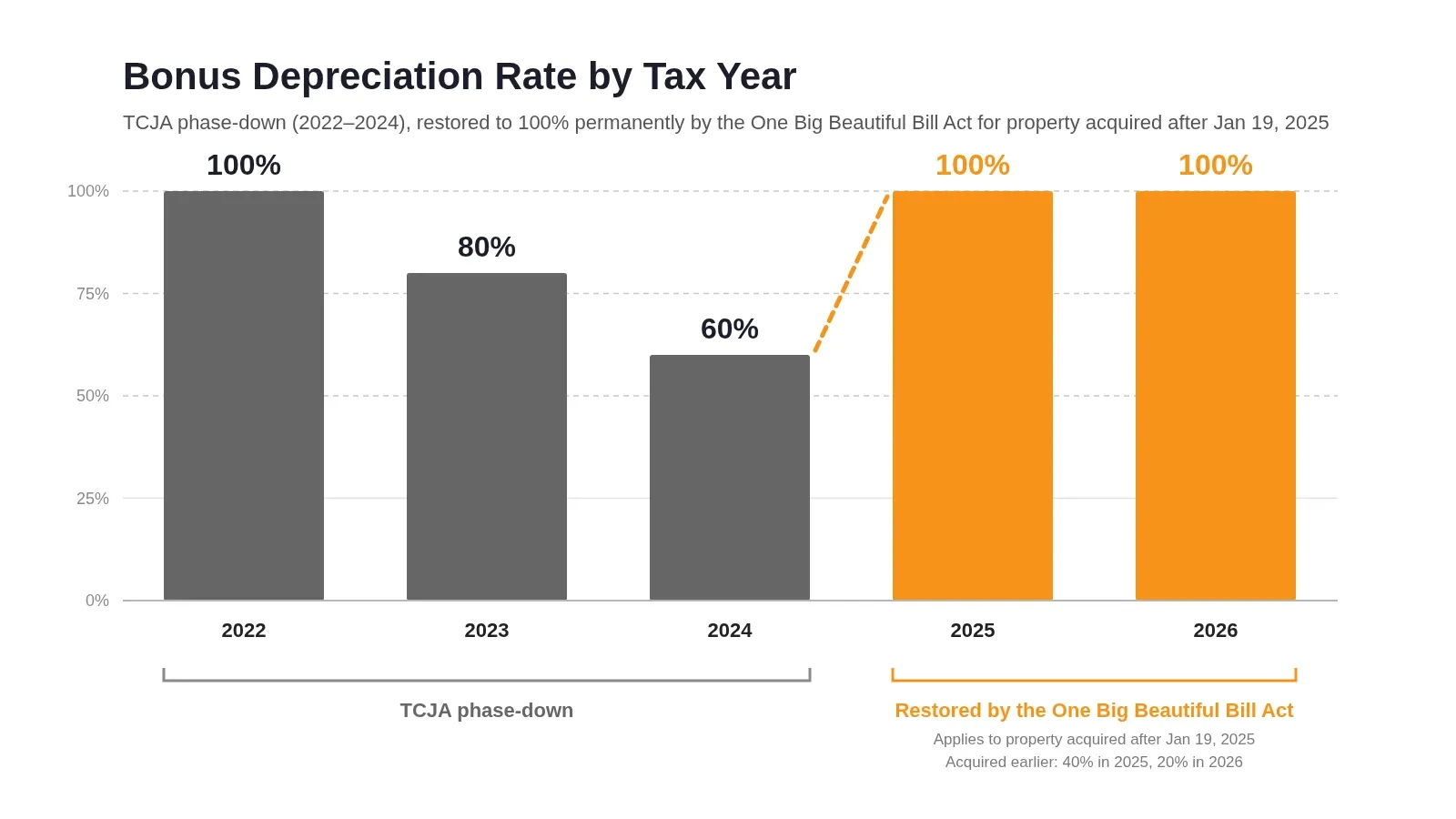
The One Big Beautiful Bill Act made 100% bonus depreciation permanent for qualifying property acquired after January 19, 2025, ending a phase-down that had cut the rate to 60% for 2024 and 40% for 2025.
Bonus Depreciation Phase-Down Before the Act
The 2017 Tax Cuts and Jobs Act raised bonus depreciation to 100% for property acquired after September 27, 2017, then scheduled a phase-down that reduced the percentage every year. By tax year 2024 the deduction had fallen to 60%, and miners faced a shrinking window each year to capture full first-year expensing on new hardware.
What Changed for Tax Year 2026
OBBB restored permanent 100% bonus depreciation for property acquired after January 19, 2025. Property acquired before January 20, 2025 (including under a binding contract signed before then) stays on the old phase-down schedule. The table below shows the rate by tax year:
| Tax Year | Bonus Depreciation Rate |
|---|---|
| 2022 | 100% |
| 2023 | 80% |
| 2024 | 60% |
| 2025 | 40% if acquired before Jan 20, 2025; 100% if acquired after Jan 19, 2025 |
| 2026 | 100% if acquired after Jan 19, 2025 (20% if acquired before Jan 20, 2025) |
For Bitcoin miners, this means a $90,000 ASIC purchase acquired after January 19, 2025 and placed in service in 2026 can generate $90,000 of first-year deductions. Combined with hosting and operating expenses, a properly structured mining business can show a paper loss in year one while producing real Bitcoin income.
Bitcoin Mining Equipment That Qualifies for Bonus Depreciation
Qualifying property must have a recovery period of 20 years or less, be used in a trade or business, and be placed in service during the tax year. For the full 100%, it must also be acquired after January 19, 2025, and used property has its own tests (below). Most Bitcoin mining hardware fits inside these rules.
ASIC Miners and Hashrate Hardware
ASIC miners (Antminers, Whatsminers, Avalons, and equivalents) are tangible personal property generally depreciated as five-year MACRS property. Air-cooled units like the Antminer S21 series and hydro-cooled units like the S21 XP Hydro and S21+ Hydro both qualify. You can buy Bitcoin miners eligible for the full deduction at any time during the tax year.
Supporting Infrastructure and Components
The deduction is not limited to the miners themselves. Other items that can qualify include:
- Power distribution units and PDUs
- Industrial cooling systems and immersion tanks
- Electrical transformers and switchgear
- Network switches, routers, and monitoring hardware
- Server racks and containerized data center modules
Miners building out their own sites can capture significant deductions on infrastructure, not just hashrate, but not every item qualifies. Equipment that serves the miners (PDUs feeding miners, immersion tanks, dedicated coolers, network gear, movable racks) is generally personal property with a short recovery period. Building wiring, general switchgear, transformers and building HVAC can count as structural parts of a building, which are 39-year property with no bonus depreciation. Containers can go either way depending on how they're installed. Classify each item with your CPA, ideally through a cost segregation study.
New vs Used Equipment Eligibility
Both new and previously owned ASICs can qualify. Used equipment qualifies only if you never used it before (including through an ownership interest in the past five years), you didn't buy it from a related party or get it by gift or inheritance, and, for the full 100%, you acquired it after January 19, 2025. A refurbished S19 purchased from a marketplace or a used S21 acquired in a fleet rotation that meets those tests supports the same first-year deduction as a brand new unit.
Browse current Bitcoin mining hardware eligible for 2026 bonus depreciation.
Business vs Hobby Classification for Bitcoin Miners
Bonus depreciation is available only when Bitcoin mining qualifies as a trade or business, not a hobby. The IRS applies a facts-and-circumstances test focused on profit motive, time invested, and how the operation is run.
IRS Profit Motive Factors
The IRS looks at the operation as a whole, using nine factors in Treas. Reg. §1.183-2(b). The ones that matter most for miners:
- Manner of operation: Is the mining run with separate accounts, clean books, and businesslike records?
- Time and effort: Does the taxpayer (or paid staff) devote regular hours to the operation?
- Profit history and expectation: Is there a reasonable expectation of profit, even if the operation hasn't produced one yet?
- Expertise: Has the operator built knowledge of hardware, pools, hosting economics, and difficulty trends?
- Financial status: Large income from other sources, especially when the activity's losses create big tax savings, can point toward a hobby. High earners need the other factors to be strong.
A miner buying ten ASICs, paying for professional hosting, tracking BTC rewards in Koinly, and monitoring a dashboard daily is operating a business. A single GPU running in a closet with no records is closer to a hobby.
Documentation That Establishes Business Intent
Mike LaLuna's tax course points to a handful of records that make the business case obvious to the IRS:
- A written business plan or investment memo
- Separate bank account (Mercury or another business-friendly bank works well)
- LLC, S-Corp, or sole proprietor filings depending on structure
- Equipment invoices and serial numbers
- Dated dashboard screenshots showing uptime and hashrate
- Mining pool statements and BTC payout records
If your records would survive a 30-minute call with an IRS examiner, you have a business. If they wouldn't, fix the records before claiming the deduction.
Section 179 vs Bonus Depreciation for Mining Hardware
While 100% bonus depreciation applies, it usually beats Section 179 for Bitcoin miners: it's automatic, has no dollar cap and can create a tax loss that offsets other income, while Section 179 cannot exceed taxable business income. Section 179 still matters for property that doesn't qualify for bonus, and in states like California and New Jersey that allow some Section 179 but no bonus.
Income and Deduction Limits Under Section 179
Section 179 lets a business expense qualifying equipment in year one, up to $2,560,000 for 2026, but the deduction is limited to taxable income from businesses you actively run. You cannot use Section 179 to create a net operating loss; anything over the limit carries forward. How the limit works depends on the entity. If a mining partnership earns $30,000 of net income before the deduction, Section 179 caps the write-off at $30,000. An S-Corp works the same way, except the owner's salary is added back before the limit is figured. A sole proprietor or single-member LLC counts all active business income, including W-2 wages, so $30,000 of mining income plus $150,000 of wages allows up to about $180,000.
When Bonus Depreciation Delivers Greater Tax Savings
Bonus depreciation has no income limitation of its own. A $200,000 hardware purchase against $100,000 of mining income generates a $100,000 loss that flows through to the operator's personal return. That loss is still limited by your basis, the at-risk rules, the material participation rules below, and the excess business loss cap ($256,000 single, $512,000 joint for 2026), with any excess carried forward.
| Feature | Section 179 | Bonus Depreciation |
|---|---|---|
| Income limitation | Yes (active business income, including W-2 wages for individuals; excess carries forward) | None of its own (losses still face the $256,000 / $512,000 excess business loss cap in 2026) |
| Can create a tax loss | No | Yes |
| Applies to new equipment | Yes | Yes |
| Applies to used equipment | Yes, if not from a related party | Yes, if not from a related party and never used by you before |
| Annual deduction cap | $2,560,000 for 2026, reduced once purchases pass $4,090,000 | None |
| Recapture on sale | Section 1245 | Section 1245 |
| State treatment | CA and NJ allow up to $25,000 | Not allowed in CA, NJ or PA |
Most miners default to bonus depreciation because the loss creation is where the real tax planning leverage lives.
Sole Proprietorship vs S-Corporation (Worked Example)
The entity structure changes the tax math even when the bonus depreciation deduction is identical. The math below uses the same approach Mike LaLuna walks through in his Bitcoin tax course, applied to the Antminer S21j XP Hydro (495 TH/s), the most purchased hardware among Simple Mining clients. Hardware price, revenue and operating cost figures are illustrative; actual results vary with hashprice and Bitcoin price.
- 10 Antminer S21j XP Hydro units at $9,000 each = $90,000 hardware purchase
- Illustrative mining revenue: $150,000
- Illustrative hosting and operating costs: $22,000
- Bonus depreciation: $90,000
- Net profit after bonus depreciation: $38,000
The $9,000 unit price is illustrative. See current pricing and volume tiers at simplemining.io/shop-miners.
As a sole proprietorship (or single-member LLC):
The $38,000 of profit is subject to self-employment tax. SE tax is calculated on 92.35% of net profit at 15.3% (12.4% Social Security up to the 2026 wage base of $184,500, plus 2.9% Medicare on all earnings).
- SE tax base: $38,000 × 92.35% = $35,093
- SE tax: $35,093 × 15.3% = ~$5,369 in self-employment tax alone
- Plus ordinary income tax on the remaining profit
As an S-Corporation:
Pay yourself a reasonable W-2 salary (30% of pre-salary profit is a common planning convention, not an IRS safe harbor), then take the rest as a distribution that escapes SE tax.
- W-2 salary: $11,400
- Employer payroll tax (corporate expense): ~$872
- Net profit to S-Corp after salary and employer payroll tax: $25,728
- Plus ordinary income tax on the $11,400 salary and the $25,728 flow-through profit
- Employee payroll tax withheld from salary: ~$872
- Total payroll tax (employer plus employee): ~$1,744
Compared like for like, the S-Corp replaces about $5,369 of self-employment tax with about $1,744 of payroll tax, a difference of about $3,625 in this scenario. That's before income tax effects and S-Corp costs like a payroll service and a separate Form 1120-S return. Both structures can claim the Qualified Business Income (QBI) deduction of up to 20%, subject to limits, but the S-Corp salary itself doesn't count as qualified income.
| Tax line item | Sole Proprietorship | S-Corporation |
|---|---|---|
| Net profit after bonus depreciation | $38,000 | $38,000 |
| W-2 salary (S-Corp only) | — | $11,400 |
| Employer payroll tax (corp expense) | — | ~$872 |
| Net flow-through profit | $38,000 | $25,728 |
| Self-employment tax | $5,369 | — |
| Ordinary income tax | varies by bracket | varies by bracket |
| Employee payroll tax | included in SE | ~$872 |
| Total tax burden | $5,369 + income tax | ~$1,744 + income tax |
| QBI deduction available? | Yes, with limits | Yes, with limits |
The takeaway: bonus depreciation is the headline, but the entity wrapper around it determines how much of the saved tax stays in your pocket.
Passive Loss Limitations and Material Participation
Bonus depreciation only offsets your W-2 income or other ordinary income if your Bitcoin mining qualifies as an active trade or business under Section 469. If the IRS classifies your mining as passive, the bonus depreciation loss can only offset passive income from any activity, this year or later. Whatever is left is released when you sell your entire interest in a fully taxable sale.
This is the single most important section of this guide. Most articles gloss over passive activity rules. The miners who get burned aren't the ones who picked the wrong hardware. They're the ones who claimed a six-figure deduction against W-2 income and then failed the material participation test on audit.
How Section 469 Restricts Mining Deductions
Under Section 469, net losses from a passive activity can only offset income from another passive activity. Passive losses cannot offset wages, salary, portfolio income, or income from active businesses you operate. Suspended passive losses carry forward until you generate passive income or dispose of the activity.
Real estate investors have carve-outs like Real Estate Professional Status and the $25,000 "mom and pop" exception. Bitcoin miners have none of those. The only path to active treatment is material participation.
Seven Tests for Material Participation
The IRS has seven material participation tests. You only need to meet one. All seven:
- The 500-hour test. You participate in the mining activity for more than 500 hours during the tax year.
- The substantially-all test. Your participation makes up substantially all of the participation in the activity by anyone (including non-owners).
- The 100-hour test. You participate for more than 100 hours and no other individual, including non-owners such as the hosting company's technicians, participates more than you do.
- Significant participation aggregate test. Your participation across all your significant participation activities (each more than 100 hours, including mining) totals more than 500 hours.
- 5-of-10 test. Material participation in five of the prior ten tax years.
- Personal service activity test. Material participation in any three prior years in a personal service activity (health, law, consulting and similar). Mining isn't a personal service activity, so this test doesn't apply.
- Facts and circumstances test. Regular, continuous, and substantial involvement for more than 100 hours. Management work doesn't count if someone else is paid to manage the activity or spends more hours managing it than you, which matters for hosted miners.
The 500-hour test and the 100-hour test are the cleanest paths for most Bitcoin miners. For hosted operators, the 100-hour test is harder than it looks, because it compares your hours with every other individual's, including the host's technicians. You need more qualifying hours than any single person at the host. Investor-type work, such as reviewing dashboards and reports or monitoring finances, doesn't count unless you're directly involved in day-to-day management or operations.
What Hosted Miners Need to Document
Hosted mining does not automatically make you passive. Material participation is determined by the shareholder's involvement, not the entity type or whether someone else racks the hardware. A miner who uses professional hosting but personally selects hardware, chooses and changes pools, sets curtailment instructions, authorizes repairs, and makes capital decisions can support an active classification.
What we see work in practice:
- Logs and calendars. Log the decisions and operational work you do yourself, the same day you do it: pool selection, curtailment instructions, repair authorizations, procurement and fleet changes. Time spent reviewing the dashboard or reading updates is generally investor-type activity and doesn't count on its own.
- Dated screenshots. Weekly captures of the Simple Mining dashboard showing hashrate, uptime, and earnings.
- Decision documentation. Emails, memos, or notes covering pool selection, curtailment decisions, repair authorizations, and upgrade plans.
- Repair tickets. Records of conversations with the in-house repair facility when units need service.
- Communication trails. Your own instructions to your hosting team, such as curtailment calls and repair approvals. Simple Mining sends proactive curtailment and uptime updates, but receiving updates isn't participation. What counts is what you decide and do in response.
Bottom line: bonus depreciation only offsets your W-2 income if your mining qualifies as active. Hosted mining can qualify, but only if you can document material participation. The dashboard and client engagement model at Simple Mining supports that documentation. It does not guarantee the classification.
For miners pursuing this strategy, the right move is to consult a CPA who handles mining returns. Mike LaLuna's firm at lcltax.com/bitcoin-mining-bookkeeping-plans specializes in exactly this question.
See how Simple Mining's hosted mining facility and client dashboard can support your material participation documentation.
How Bitcoin Mining Compares to Real Estate Depreciation
Bitcoin mining and real estate are the two main asset classes Americans use to convert capital into depreciation deductions. Mining offers faster first-year expensing and returns that can run higher but swing more. Real estate offers longer asset lives and (in some cases) easier passive activity carve-outs.
Returns and Scalability
Real estate returns tend to be steadier. Bitcoin mining returns swing more and can run higher when hashprice is strong. Returns vary significantly with Bitcoin price, network difficulty, and hosting rates. Scaling mining means buying more ASICs and adding hosting slots. Scaling real estate means hunting for new properties, closing on them, and managing tenants.
Liquidity and Exit Flexibility
ASIC miners can be sold within days through a marketplace or peer transaction. Real estate sales take months and involve agents, inspections, financing contingencies, and closing costs. Mining hardware can also be relocated. A property cannot.
Operating Costs and Management Complexity
Hosted mining at Simple Mining comes with a single all-in hosting fee that covers hosting, monitoring, maintenance, and site operations. Real estate carries property taxes, insurance, repairs, vacancies, tenant management, and unpredictable capital expenditures. The operational surface area is smaller with mining.
The trade-off: real estate has 27.5- or 39-year depreciation schedules that produce slow, predictable shelter. Mining concentrates the deduction in year one. Different strategies for different planning horizons.
Additional Tax Deductions for Bitcoin Mining Operations
Beyond the depreciation deduction on hardware, ongoing mining operations generate deductible expenses every month. These reduce taxable mining income further.
Hosting Fees
Monthly hosting fees paid to a colocation provider are fully deductible as ordinary business expenses. Hosted customers pay a single all-in hosting fee that covers hosting, infrastructure, monitoring, and site operations. The full amount is deductible. Prepaid hosting is deductible right away only if the benefit doesn't extend more than 12 months (and not past the end of the next tax year), and refundable deposits aren't deductible.
Repairs and Maintenance Expenses
Repair costs on Bitcoin miners are deductible. New miners purchased from Simple Mining include 12 months of Miner Protection covering all parts and labor with no dollar cap, fans included. After year one, clients can stay covered on a paid Standard or Premium protection plan, which includes a $500 annual parts allowance per miner, or pay for repairs at the in-house repair facility as needed. Parts, labor, and shipping for any uncovered repair are all deductible.
Other Deductible Operating Costs
A complete list of common deductions for a Bitcoin mining business:
- Hosting fees
- Repairs, replacement parts, and shipping
- Mining pool fees (Luxor, NiceHash, Ocean, etc.)
- Internet and networking costs at any owned sites
- Professional services (CPA, attorney, bookkeeper)
- Business banking fees
- Software subscriptions (Koinly, accounting tools)
- Conference travel directly tied to the mining business
Track each line item monthly. The combination of bonus depreciation plus operating expenses is what produces meaningful net losses in year one.
Documentation Requirements for Mining Depreciation Claims
Records made at the time are your strongest support for every claimed deduction. The rules let you prove participation by any reasonable means, but records reconstructed later carry less weight in an audit. Real-time tracking strengthens your position.
Essential Records for Audit Protection
Maintain at minimum:
- Purchase invoices showing the date, amount, and serial numbers of each unit
- Proof of payment (bank transfers, ACH receipts, wire confirmations)
- Placed-in-service documentation (installation date, first hashrate reported)
- Business use records (dashboard screenshots, uptime logs, pool payouts)
- Income and expense logs tied to the operation's bank account
- Material participation logs if you're claiming active treatment
How Mining Dashboards Support Compliance
A professional hosting dashboard creates a contemporaneous business record automatically. Simple Mining's dashboard logs hashrate, uptime percentage, billing line items, and pool earnings in real time. The Repair Report Dashboard logs every service event. Both are downloadable, dated, and tied to the specific machines in your account. That kind of audit trail is exactly what the IRS wants to see when it asks how you knew your equipment was placed in service on a specific date and operating throughout the year.
Depreciation Recapture When Selling Mining Equipment
When you sell a previously depreciated ASIC, the IRS recaptures the depreciation as ordinary income up to the amount of depreciation previously claimed. Any gain above the original purchase price is Section 1231 gain for business property held more than a year, which is generally taxed as long-term capital gain.
Example: You bought an Antminer S21j XP Hydro for $9,000 and claimed $9,000 of bonus depreciation in year one. Two years later you sell the unit for $4,500. Your adjusted basis is $0 (fully depreciated), so the entire $4,500 sale price is depreciation recapture taxed at ordinary income rates under Section 1245. Unlike real estate, which gets a 25% cap on unrecaptured Section 1250 gain, personal property recapture is taxed at your full marginal rate, which can reach 37% (the 2026 top rate, on taxable income over $640,600 single or $768,700 joint).
Plan for this at exit. If you intend to sell a fleet during a strong hardware market, the recapture can be significant. Strategies to manage it include staggering sales across tax years and reinvesting proceeds in new hardware (which generates fresh bonus depreciation to offset the recapture). A 1031 exchange isn't an option: since 2018, like-kind exchange treatment applies only to real property, so mining equipment doesn't qualify.
Recapture applies to the mining hardware. The Bitcoin you mined is taxed separately. It's ordinary income at its fair market value on the day you receive it (and subject to self-employment tax if you mine as a business), and that value becomes your basis. When you sell it, Bitcoin capital gains rules apply, and if any of those holdings are underwater you can harvest the losses to offset your gains.
FAQs
Can I claim bonus depreciation if my Bitcoin miners are hosted by a third party?
Yes. Ownership of the hardware and qualification as a trade or business are what matter. A hosting provider operating the machines on your behalf does not disqualify the deduction. Material participation is still required if you want to offset W-2 income, and the excess business loss cap ($256,000 single, $512,000 joint for 2026) still applies.
Does bonus depreciation apply to used or refurbished ASIC miners?
Yes, with conditions. Used equipment qualifies if you never used it before, didn't buy it from a related party or receive it by gift or inheritance, and use it in your trade or business. For the full 100%, it must also be acquired after January 19, 2025. A refurbished S19 that meets those tests and is placed in service in 2026 supports the same first-year deduction as a new unit.
How do state taxes treat Bitcoin mining depreciation deductions?
State treatment varies. Some states conform to federal bonus depreciation. Others require multi-year depreciation regardless of federal rules. California, Pennsylvania and New Jersey don't allow federal bonus depreciation, and California and New Jersey cap Section 179 at $25,000, so those returns need separate depreciation calculations. Iowa, where Simple Mining hosts, follows federal bonus depreciation. Confirm with a CPA familiar with your state.
What happens to my depreciation deduction if I pause my Bitcoin mining operation?
A pause does not automatically disqualify prior depreciation claims. Extended inactivity (multiple years with no hashing, no income, no operational decisions) can raise hobby reclassification questions on audit. Document the reason for the pause and the date you intend to resume.
Can I claim bonus depreciation on Bitcoin miners purchased late in the tax year?
Yes, if the unit was acquired after January 19, 2025 and you don't elect out of bonus depreciation. Equipment placed in service at any point during the tax year then qualifies for the full 100%, so a unit installed and hashing on December 30, 2026 produces the same deduction as one installed on January 2, 2026. The placed-in-service date is what matters, not the number of operational days in the year. Timing does matter if you elect out: when more than 40% of a year's equipment goes into service in the fourth quarter, the mid-quarter convention cuts the first-year deduction on five-year property from 20% to 5%.
Run the Tax Math Before You Buy
Bonus depreciation rewards miners who treat their operation like a business. The deduction is generous, the rules are clear, and the audit risk is manageable when the records are clean.
Disclaimer: This article is for educational purposes only and does not constitute tax, legal, or financial advice. Tax laws change frequently and individual situations vary. Consult a qualified CPA or tax professional before making decisions based on this information. Simple Mining partners with Mike LaLuna, CPA at LCL Tax, who specializes in Bitcoin mining taxation and can be reached at lcltax.com. State tax treatment of bonus depreciation varies. Some states conform to federal rules. Others require multi-year depreciation. Confirm with your state's tax authority or a CPA familiar with your state.
The miners who capture the most value combine three things: the right hardware, hosted operations that support material participation, and a CPA who handles mining returns every year. Simple Mining provides the first two. Mike LaLuna's firm provides the third.
Schedule a call with our team to discuss equipment, hosting, and how Mike LaLuna's tax expertise integrates with your mining setup.