

Antminer S21+ Hydro Review: 2026 Specs & Profitability
By Josh Heine, Content Strategist at Simple Mining
Published April 13, 2026
The Antminer S21+ Hydro delivers up to 395 TH/s at 15 J/TH. It sits at the entry point of Bitmain's hydro-cooled lineup in three hash rate tiers (338, 358, and 395 TH/s), offering liquid cooling benefits at a lower price than the XP-class models above it.
This review covers specs, real-world performance, infrastructure requirements, and profitability math. It also compares the S21+ Hydro against the S21e XP Hydro and S21 XP Hydro so you can determine which machine earns its rack space.
On this page · 12 sections
- Antminer S21+ Hydro Full Specifications
- How Hydro Cooling Works on the S21+ Hydro
- S21+ Hydro Real-World Performance
- S21+ Hydro Infrastructure Requirements
- How Loud Is the S21+ Hydro Compared to Air-Cooled Miners
- S21+ Hydro Profitability and ROI Analysis
- S21+ Hydro vs S21 XP Hydro, S21e XP Hydro, and S21 XP Air
- Who Should Buy the Antminer S21+ Hydro
- Maintenance and Common Failure Points
- Should You Wait for Newer Hydro Models
- Is the S21+ Hydro Right for Your Mining Operation
- FAQs About the Antminer S21+ Hydro
Key Takeaways
- The Antminer S21+ Hydro delivers 338 to 395 TH/s at 15 J/TH across three tiers, sitting at the entry point of Bitmain's hydro-cooled lineup.
- Simple Mining carries three variants (338, 358, and 395 TH) so buyers can match hashrate to budget.
- At hosted rates of $0.065-$0.08/kWh the S21+ Hydro produces positive margins, though tighter than XP-class models at 12-13 J/TH.
- Operators with capital for premium hardware should evaluate the S21e XP Hydro (13 J/TH) or S21 XP Hydro (12 J/TH) for better long-term efficiency.
- Professional hosting eliminates the CDU and plumbing buildout that often costs more than the miner itself.
Antminer S21+ Hydro Full Specifications
The S21+ Hydro is a liquid-cooled Bitcoin miner built for operators who want hydro efficiency without the premium of XP-class hardware. Simple Mining carries three hash rate tiers. All achieve 15 J/TH efficiency.
| Specification | 395 TH | 358 TH | 338 TH |
|---|---|---|---|
| Hashrate | 395 TH/s (±3%) | 358 TH/s (±3%) | 338 TH/s (±3%) |
| Power Consumption | 5,925W (±5%) | 5,370W (±5%) | 5,070W (±5%) |
| Efficiency | 15 J/TH | 15 J/TH | 15 J/TH |
| Cooling | Hydro (liquid) | Hydro (liquid) | Hydro (liquid) |
| Voltage | 380-415V 3-phase | 380-415V 3-phase | 380-415V 3-phase |
| Noise | ~50 dB | ~50 dB | ~50 dB |
| Algorithm | SHA-256 | SHA-256 | SHA-256 |
| Warranty | 365 days | 365 days | 365 days |
The only difference between tiers is hashrate and power draw. Higher bins hash faster while consuming proportional wattage. All three share the same chassis and cooling architecture.
Hash Rate and Efficiency at 15 J/TH
Hash rate measures how many trillion hashes per second (TH/s) a miner computes. Efficiency (J/TH) tells you how much energy each terahash costs. All three S21+ Hydro tiers achieve 15 J/TH. The difference is output: the 395 TH produces 17% more hashrate than the 338 TH while consuming proportional power.
Power Consumption and Electrical Draw
The 395 TH draws 5,925W. The 358 TH draws 5,370W. The 338 TH draws 5,070W. Bitmain's ±5% tolerance means real draw can exceed rated specs. Plan circuits for worst-case draw.
At Simple Mining, precision billing charges at nameplate power rather than wall draw. That saves hosted clients about 5% on electricity costs.
Physical Dimensions and Weight
All three tiers share the same compact hydro chassis at under 15 kg. They're lighter than most air-cooled Antminers despite including integrated water blocks.
How Hydro Cooling Works on the S21+ Hydro
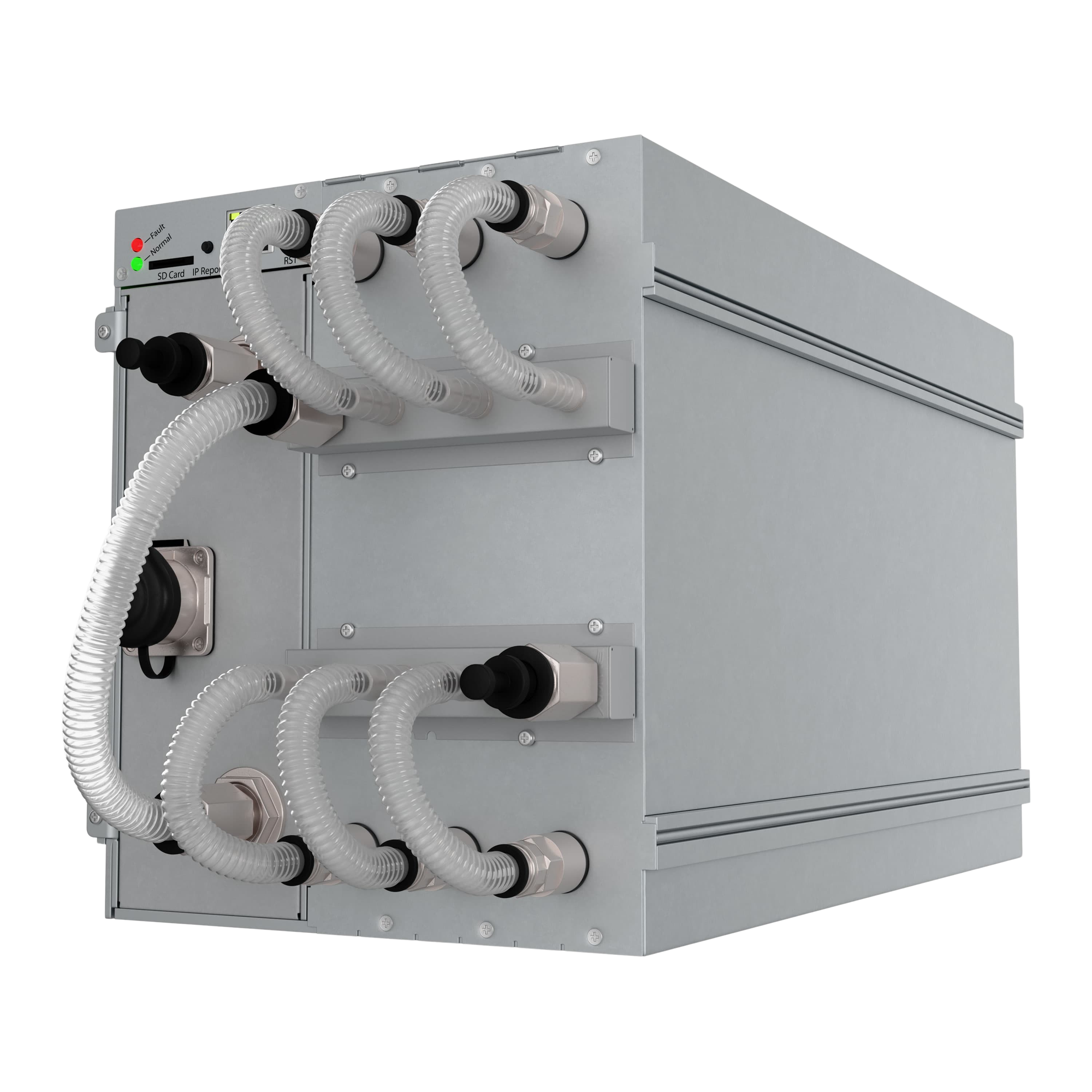
Water flows through integrated copper blocks on each hashboard. Heat transfers into the coolant and exits through quick-connect fittings to an external CDU.
Water Loop and Heat Dissipation
Water blocks sit on each hashboard. As chips hash, coolant absorbs thermal energy and carries it away. Liquid transfers heat about 25 times better than air. This enables lower chip temperatures and more consistent performance than fan-based cooling.
CDU and Coolant Requirements
A CDU (Coolant Distribution Unit) pumps, cools, and filters the liquid circulating through your miners. Flow rate targets are 8.0-10.0 L/min per unit.
Use deionized water with biocide or manufacturer-approved coolant. Tap water corrodes water blocks within months and voids your warranty.
S21+ Hydro Real-World Performance
Hydro cooling maintains stable chip temperatures that produce consistent hashrate with less variance than air-cooled units.
Hashrate Consistency Under Load
Air-cooled miners in hot environments experience hashrate swings as ambient temperatures shift. The S21+ Hydro eliminates this problem. Coolant maintains steady chip temperatures regardless of external conditions.
Actual Power Draw vs Stated Specs
Real-world power draw varies by ±5% from spec sheet numbers depending on input voltage and ambient temperature. Measure at the wall for accurate cost projections. CDU power consumption adds 5-15% on top of the miner's draw.
Thermal Performance and Operating Temperatures
Under proper hydro cooling, chips run between 50-65°C. Air-cooled units often hit 75-85°C or higher. Lower temperatures extend chip lifespan and reduce degradation. Thermal throttling is rare when the cooling system maintains spec.
S21+ Hydro Infrastructure Requirements
The S21+ Hydro requires dedicated electrical circuits, a closed-loop coolant system, and a facility with controlled conditions.
Electrical Setup and Power Delivery
All three S21+ Hydro tiers require 380-415V three-phase power. This is industrial-grade electrical service not available in standard residential settings.
Dedicated circuits with breakers rated for continuous load are essential. The 395 TH variant draws close to 6 kW per unit.
Plumbing and Water Connections
Quick-disconnect fittings connect the miner to your coolant loop. Flow rate targets are 8.0-10.0 L/min per unit. Leak detection sensors under every unit are non-negotiable.
CDU Sizing and Heat Rejection
Your CDU must handle the combined heat output of every connected miner with 20% headroom. The 395 TH variant produces about 5.9 kW of heat per unit. A dry cooler or chiller rejects that heat to ambient air.
Environmental and Facility Considerations
Ambient temperatures between 5-40°C work best. Humidity control prevents condensation. For operators who find the infrastructure investment exceeds the miner cost, professional hosting with hydro-ready facilities eliminates the buildout.
How Loud Is the S21+ Hydro Compared to Air-Cooled Miners
At about 50 dB the S21+ Hydro is quieter than a normal conversation. Air-cooled Antminers at 75+ dB sound like a vacuum cleaner, and the decibel math behind data center noise explains why that gap sounds larger than 25 points.
CDU pumps and dry cooler fans add some noise but the total system stays far quieter than air-cooled machines. For noise-restricted zones, hydro remains the only viable path to high-output mining.
S21+ Hydro Profitability and ROI Analysis
At hosted rates of $0.065-$0.08/kWh the S21+ Hydro produces positive margins under current conditions, though tighter than XP-class models.
Current Mining Economics
The 395 TH variant consumes 142.2 kWh per day (5.925 kW × 24 hours). The 338 TH variant consumes 121.68 kWh per day. Revenue varies with hashprice. Use the Simple Mining Bitcoin Mining Calculator to model scenarios with live data.
Break-Even Electricity Cost
Daily electricity cost for the 395 TH variant at common hosting rates:
| Electricity Rate | Daily kWh Cost |
|---|---|
| $0.065/kWh | $9.24 |
| $0.07/kWh | $9.95 |
| $0.075/kWh | $10.67 |
| $0.08/kWh | $11.38 |
| $0.10/kWh | $14.22 |
| $0.12/kWh | $17.06 |
At rates above $0.08/kWh, margins on a 15 J/TH machine compress fast. The lower the tier you choose, the lower the daily electricity cost, but the revenue drops in proportion. Check current Bitcoin hashprice to model live revenue against your hosting rate.Total Cost of Ownership
- Hardware: Varies by variant and market conditions
- Infrastructure: CDU, plumbing, and electrical ($5,000-$20,000+ for DIY builds)
- Electricity: 75-85% of total operating cost
- Maintenance: Coolant, filters, pump servicing
- Repairs: Component failures beyond coverage period
Hosted operations simplify this to hardware plus monthly electricity at the hosting rate.
S21+ Hydro vs S21 XP Hydro, S21e XP Hydro, and S21 XP Air
The S21+ Hydro sits at the entry point of Bitmain's hydro lineup. Here's how it compares.
| Model | Hashrate | Efficiency | Cooling |
|---|---|---|---|
| S21+ Hydro | 338-395 TH/s | 15 J/TH | Liquid |
| S21e XP Hydro | 430 TH/s | 13 J/TH | Liquid |
| S21 XP Hydro | 473 TH/s | 12 J/TH | Liquid |
| S21 XP (Air) | 270 TH/s | 13.5 J/TH | Air |
S21+ Hydro vs S21 XP Hydro
The S21 XP Hydro pushes 473 TH/s at 12 J/TH. Compared to the 358 TH/s tier of the S21+ Hydro, it delivers 32% more hashrate and 20% better efficiency. The trade-off is price: the S21 XP Hydro costs more upfront. For operators optimizing long-term electricity costs, the XP's efficiency advantage compounds over every hour of operation.
S21+ Hydro vs S21e XP Hydro
The S21e XP Hydro delivers 430 TH/s at 13 J/TH. It offers 20% more hashrate and 13% better efficiency than the S21+ Hydro. Both require similar hydro infrastructure. The S21e XP Hydro is the stronger value for operators who can absorb the higher purchase price.
S21+ Hydro vs S21 XP Air-Cooled
The S21 XP air-cooled delivers 270 TH/s at 13.5 J/TH on standard 220-277V power with no plumbing required. The S21+ Hydro offers more hashrate (358 vs 270 TH/s) but at worse efficiency (15 vs 13.5 J/TH). For operators without hydro infrastructure, deploying air-cooled units avoids the CDU and plumbing investment.
Who Should Buy the Antminer S21+ Hydro
Ideal Buyer Profiles
Operators with existing hydro infrastructure who want to expand capacity at a lower per-unit cost. Facilities in hot climates where air cooling struggles. Operations that need quiet deployment (50 dB vs 75+ dB). Investors who want hydro-cooled hardware without building infrastructure can purchase through Simple Mining and deploy into hosted facilities with hydro capacity already in place. The three hash rate tiers (338, 358, 395 TH) let buyers match output to budget.
Who Should Consider Alternatives
Operators with capital for XP-class hardware should evaluate the S21e XP Hydro or S21 XP Hydro for better long-term efficiency. First-time miners without hydro infrastructure find simpler deployment with air-cooled models. Operators paying above $0.08/kWh need the tighter margins of more efficient machines.
Maintenance and Common Failure Points
Hydro miners require regular coolant monitoring and fitting inspections. Corrosion and coolant leaks cause most unplanned downtime.
Routine Maintenance Tasks
- Weekly: Check coolant levels and flow rates
- Monthly: Inspect fittings for leaks and clean inline filters
- Quarterly: Test coolant pH and conductivity; replace degraded coolant
- Annually: Full system inspection including pump evaluation
Common Failure Modes
Pump failures stop coolant flow and cause rapid overheating. Fitting leaks allow coolant to contact electronics. Coolant contamination corrodes water block channels over time. Watch for rising chip temperatures and unusual pump sounds.
Warranty and Repair Considerations
Units purchased from Bitmain include a 365-day manufacturer warranty covering manufacturing defects (improper cooling setup is excluded). Units purchased through Simple Mining include 12 months of repair coverage through the Miner Protection Plan, which covers hashboard and PSU failures with no shipping delays.
Simple Mining operates a Bitmain-certified repair facility with in-house technicians. Repairs happen on-site in Iowa rather than shipping overseas.
Should You Wait for Newer Hydro Models
Bitmain releases new models on a regular cycle. The S23 Hydro (9.5 J/TH) offers better efficiency at a higher price point.
Every day without hashing is lost revenue. If the S21+ Hydro produces positive ROI at your electricity rate today, deploying now generates Bitcoin that waiting cannot recapture.
Is the S21+ Hydro Right for Your Mining Operation
The Antminer S21+ Hydro offers liquid-cooled efficiency at the most accessible price point in Bitmain's hydro lineup. At 15 J/TH it performs well at rates at or below $0.08/kWh.
For operators with hydro-ready facilities or access to professional hosting, it provides a lower entry point than XP-class hardware while delivering the thermal stability that makes hydro valuable.
The machine that mines today earns Bitcoin that the machine on order cannot.
Schedule a call with Simple Mining to explore S21+ Hydro availability and hosting options.
FAQs About the Antminer S21+ Hydro
How much electricity does the Antminer S21+ Hydro consume daily?
The 395 TH variant consumes about 142.2 kWh per day. The 358 TH consumes 128.88 kWh. The 338 TH consumes 121.68 kWh. Multiply by your local rate to calculate daily power cost.
Can the S21+ Hydro be hosted through a managed provider?
Yes. Professional hosting providers operate the infrastructure and handle maintenance while you retain ownership of the hardware and mining rewards. Simple Mining offers hydro-capable hosting in Iowa.
What happens if the hydro cooling system develops a leak?
Modern hydro miners include leak detection that triggers automatic shutdown. Prompt repair by certified technicians prevents permanent damage to hashboards and control boards.
What warranty and protection options cover hydro miners?
Units purchased from Bitmain carry a 365-day manufacturer warranty. Units purchased through Simple Mining receive a 12-month Miner Protection plan covering hashboard and PSU failures at no additional cost.
How does the S21+ Hydro compare to the S21 XP Hydro?
The S21 XP Hydro delivers 473 TH/s at 12 J/TH, offering 32% more hashrate and 20% better efficiency. It costs more upfront but produces lower electricity costs per terahash over the life of the machine.
Does the S21+ Hydro run on standard residential power?
No. All three variants (338, 358, 395 TH) require 380-415V three-phase industrial power. Standard residential 120/240V single-phase will not work. Professional hosting facilities provide the required electrical infrastructure.