
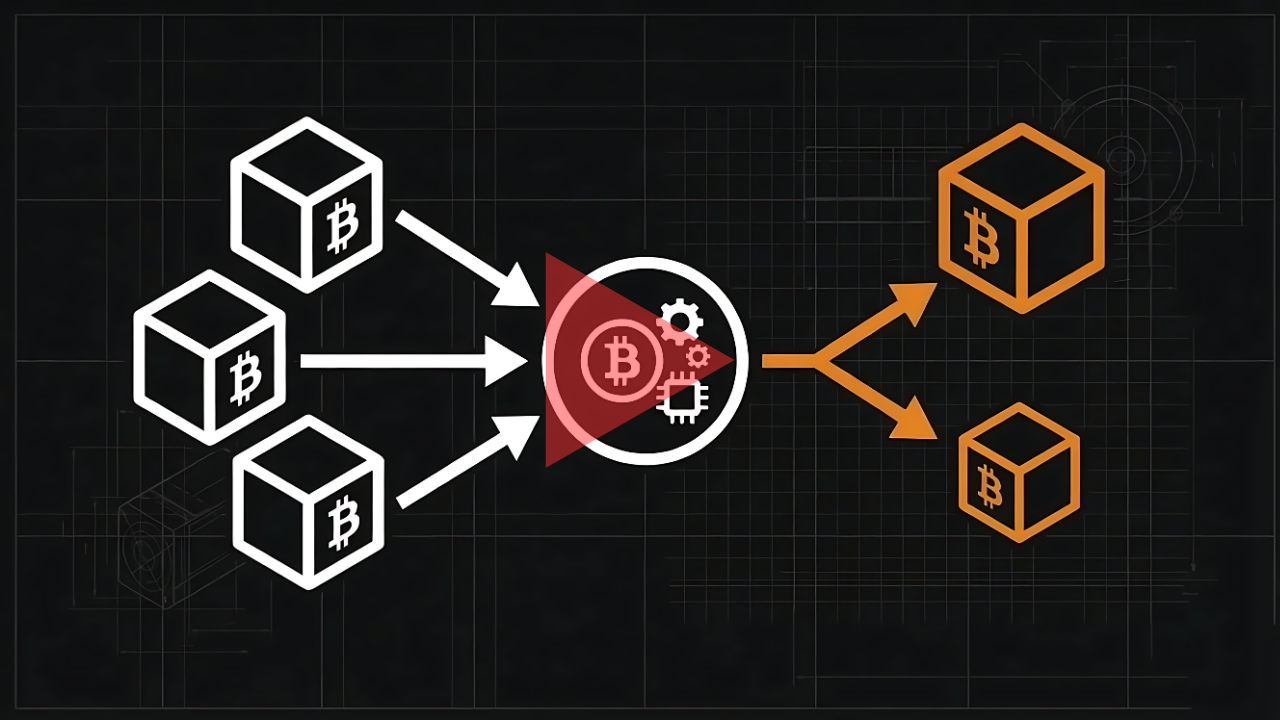
This short video explains what a UTXO is, how Bitcoin transactions create and consume them, and why UTXO management matters for transaction fees. Below you'll find the full transcript and FAQs. For a deeper look at UTXOs, consolidation strategies, and fee optimization, read the full written guide on what a UTXO is.
Read the full guide: What is a UTXO?
Full Transcript
What is a UTXO?
A UTXO is a unit of Bitcoin and an acronym for unspent transaction output. Bitcoin does not operate like a traditional bank account, where transactions are added to or subtracted from your total balance. It behaves more like cash in your wallet.
Any amount of Bitcoin can be a UTXO. If you buy a $75 steak with a $100 bill, you might receive $20 and $5 in change. In this analogy, the $100 bill is the spent transaction input, and the $20 and $5 bills are the unspent transaction outputs.
Bitcoin works the same way digitally. Spent inputs are consumed and new unspent outputs are created at the receiving address. The number of UTXOs you have impacts your transaction fee. Remember that one Bitcoin equals 100 million satoshis.
Sats per virtual byte measures the fee rate required for different priority levels and transaction sizes on the Bitcoin network.
The more UTXOs you have (or the more small chunks of Bitcoin data you hold), the higher your transaction fee can be. If you have many small UTXOs, your Bitcoin could become difficult to spend during high-fee periods.
This is why it can be important to consolidate your UTXOs. To do this, select the UTXOs you want to combine and send them to your own address, preferably when fees are low.
Some people say a 1 million satoshi UTXO minimum is a good target, but the best size depends on your total Bitcoin holdings.
To learn more about Bitcoin, visit simplemining.io.
FAQs
What is a UTXO in simple terms?
A UTXO (unspent transaction output) is a chunk of Bitcoin that you've received but haven't spent yet. Think of it like a bill in your physical wallet. Your total Bitcoin balance is the sum of all your individual UTXOs, not a single number in an account ledger.
How do UTXOs affect transaction fees?
Every UTXO you include in a transaction adds data to that transaction. More data means a larger transaction size, which means a higher fee. If you hold many small UTXOs, a simple transfer can become expensive because the network charges based on transaction size in virtual bytes.
What is UTXO consolidation?
Consolidation is the process of combining multiple small UTXOs into one larger UTXO by sending them to your own address. The best time to consolidate is when network fees are low. This reduces the data size (and cost) of future transactions when fees may be higher.
What is a good UTXO size?
A common guideline is to keep UTXOs at or above 1 million satoshis (0.01 BTC). However, the right size depends on your total holdings and how you plan to spend. Larger UTXOs give you more flexibility during high-fee periods because they're cheaper to move relative to their value.
How is Bitcoin different from a bank balance?
A bank balance is a single number that goes up or down with each transaction. Bitcoin doesn't work that way. Your wallet holds a collection of individual UTXOs, each a separate chunk of value, and spends them like individual bills rather than drawing from a pooled total.
What are sats per vbyte?
Sats per vbyte (satoshis per virtual byte) is the unit that measures Bitcoin transaction fee rates. A higher sats-per-vbyte rate means your transaction gets confirmed faster. The rate fluctuates based on network demand, which is why timing matters for consolidation and large transfers.
By Josh Heine, Content Strategist at Simple Mining
Published: September 10, 2024
Modified: March 10, 2026