

Solo Mining vs Pool Mining: Which Strategy Wins in 2026
By Josh Heine, Content Strategist at Simple Mining
Updated September 23, 2026Published May 11, 2026
Solo mining points one operator's hashrate at the entire Bitcoin network without any partners. Pool mining splits work across thousands of miners and shares rewards based on contribution. Network hashrate sits near 941.88 EH/s as of September 2026, which puts solo mining out of reach for any operator below industrial scale. Pool mining wins for most miners because it converts a multi-decade lottery into steady daily income.
On this page · 13 sections
- What Is Solo Mining
- How BTC Solo Mining Works
- Pros and Cons of Solo Mining
- What Is Pool Mining
- How Bitcoin Mining Pools Work
- Pros and Cons of Pool Mining
- Solo vs Pool Mining Side-by-Side
- Is Solo Mining Worth It for Most Miners
- How to Choose Between Solo and Pool Mining
- The Bitcoin Solo Pool Hybrid Strategy
- Which Strategy Works Best for Hosted Miners
- FAQs
- Why Pool Mining Wins for Most Miners in 2026
Key Takeaways
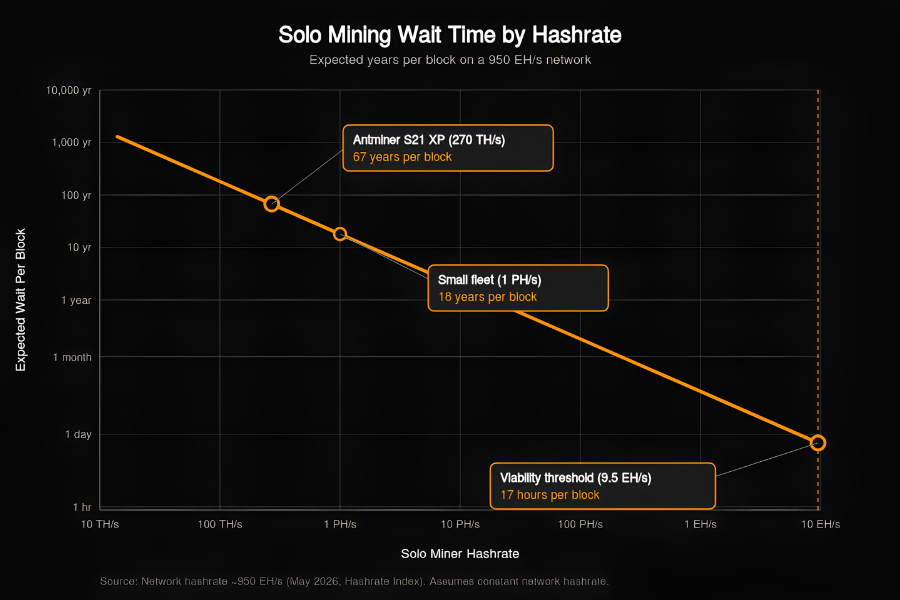
- A single Antminer S21 XP at 270 TH/s on a 941.88 EH/s network has a 1-in-66-year average wait per block, which makes solo mining unviable below industrial scale.
- Pool mining delivers daily payouts based on hashrate contribution, with fees of 0% to 4% (most FPPS pools sit between 1% and 2.5%).
- Solo mining only makes economic sense at 9.5 EH/s or more of dedicated hashrate, equal to about 35,000 Antminer S21 XP-class miners.
- A solo pool hybrid (90-95% pool, 5-10% solo) is the only realistic way for smaller operators to keep solo upside without sacrificing cash flow.
- Hosted Bitcoin miners benefit most from pool mining: daily payouts align with billing cycles, dashboards centralize monitoring, and providers handle pool configuration.
What Is Solo Mining
Solo mining is Bitcoin mining without joining a pool, where one operator competes against the entire network for the full block reward. You point your ASICs at the protocol through your own full node and mining software. The payout is binary. You either find a block and claim 3.125 BTC plus transaction fees, or you find nothing.
How BTC Solo Mining Works
Solo mining sends hashes to a Bitcoin full node you operate, which assembles candidate blocks and broadcasts the winner if your hardware finds one. The setup runs on three steps:
- Hash submission: Your ASIC generates hashes targeting the network difficulty.
- Block discovery: A valid hash gets packaged into a block and broadcast to peers.
- Reward claim: The full coinbase reward plus transaction fees route to your wallet.
Solo mining requires a synced full node (the chain is over 740 GB in 2026), reliable internet, and mining software like ckpool configured to point at your own infrastructure. Any downtime kills your share of the network race.
Pros and Cons of Solo Mining
Solo mining keeps 100% of every block reward but delivers payouts so rare that most operators below industrial scale never see one. Here are the trade-offs that matter.
Full Block Rewards with No Pool Fees
Solo miners keep the full 3.125 BTC plus transaction fees on every block they find. There is no operator fee, no FPPS spread, and no pool cut. This is the headline financial argument for going solo.
Complete Control and Privacy
Solo miners pick their own software, wallet addresses, and transaction selection rules. No pool operator sees hashrate or earnings data. You also choose which transactions to include in each block, which gives you direct influence over your own block template.
Near-Zero Block Discovery Odds
A single Antminer S21 XP at 270 TH/s would expect to find a block on average every 66 years against a 941.88 EH/s network. Older gear like the S19j Pro at 100 TH/s pushes that wait to about 179 years. Mempool.space tracks live solo probability for any hashrate.
Unpredictable Income and High Variance
No steady payouts means no cash flow. A solo miner can run for years with zero revenue while power costs, hosting fees, and depreciation accumulate every month. That makes ROI modeling and break-even forecasting impossible at any honest level of confidence.
Significant Hardware and Technical Requirements
Solo mining requires a full Bitcoin node, mining software you configure yourself, hardware investment in the thousands per ASIC, and the operational expertise to keep both the node and the rigs online. Most home or small-fleet operators cannot justify the cost or complexity.
What Is Pool Mining
Pool mining combines hashrate from many miners into a single coordinated effort, with rewards split based on each miner's contribution. This is how the vast majority of Bitcoin hashrate routes today. For a beginner-friendly walkthrough of how Bitcoin mining pools work, see our explainer.
How Bitcoin Mining Pools Work
Mining pools coordinate work across all participants, validate proof of contribution through "shares," and distribute rewards when the pool finds a block. The basic flow is:
- You connect your ASIC to the pool's stratum server.
- Your hardware submits valid shares as proof of work performed.
- When the pool finds a block, the reward splits across miners based on shares submitted.
Common payout methods include FPPS (full pay per share) and PPLNS (pay per last N shares). Each handles variance and timing differently. See our mining pool payouts guide for the detailed breakdown.
Pros and Cons of Pool Mining
Pool mining trades a small operator fee for predictable income and operational simplicity. The drawbacks center on fees and centralization concerns.
Consistent and Predictable Payouts
Pool miners earn revenue based on actual hashrate contribution rather than block luck. A 270 TH/s rig running on FPPS earns the same proportional share every day, which makes ROI math possible. You can model break-even with a Bitcoin mining calculator before committing capital.
Lower Barrier to Entry
Pool mining works at any hashrate. A single hosted ASIC, a 10-rig home setup, or a 100 MW fleet all earn proportional rewards. You do not need a full node, custom software, or massive infrastructure to start.
Reduced Risk and Variance
Shared luck across thousands of miners smooths out the swings. You earn something every day instead of waiting decades for one block, the same long-run pace at which a single machine grinds toward 1 Bitcoin. This is the central reason pools dominate Bitcoin hashrate distribution.
Pool Fees Reduce Total Rewards
Major pools charge between 0% and 4% on rewards, with most FPPS pools landing in the 1% to 2.5% range. PPLNS structures often run at 0% to 2%. Over time these fees compound, but they are the cost of converting variance into stable income.
Centralization and Trust Considerations
A small number of pools control the majority of Bitcoin hashrate. Pool operators select which transactions go into blocks, which gives them influence over censorship and policy. Choosing a pool aligned with your values matters more than chasing the lowest fee.
Solo vs Pool Mining Side-by-Side
The four factors that decide most strategies are payout structure, frequency, requirements, and risk. For real-time pool data and hashrate share, see our live Bitcoin mining pool comparison.
| Factor | Solo Mining | Pool Mining |
|---|---|---|
| Reward per block | Full 3.125 BTC + fees | Proportional share |
| Payout frequency | Once every ~66 years (single S21 XP) | Daily |
| Minimum hashrate | 1% of network for viability | Any amount |
| Fees | None | 0% to 4% |
| Technical complexity | High | Low |
| Income variance | Near-infinite | Near-zero |
Profitability and ROI Potential
Solo mining offers higher theoretical upside per block but lower expected value over time once variance and downtime are factored in. Pool mining delivers reliable returns you can model and budget against. For a deeper look at the economics, see our breakdown of whether is Bitcoin mining still profitable.
Reward Frequency and Payout Structure
Solo mining produces rare jackpots. Pool mining produces daily payouts. The difference matters most for operators who need cash flow to cover hosting fees, power costs, and other operating expenses.
Hardware and Power Requirements
Both strategies require ASICs and power. The cost structure is what changes.
For hosted operations, all-in hosting rates of $0.065 to $0.08 per kWh let any pool-mining hashrate cover power and operations. For home setups, residential electricity rates of $0.12 to $0.18 per kWh make even pool mining tight on margin and solo mining a non-starter without scale. See the full math in our cost to mine 1 Bitcoin breakdown.
Risk and Income Variance
Solo mining is high-variance gambling. Pool mining smooths variance into a predictable stream. For investors and operators with monthly bills to pay, predictability is the deciding factor.
Is Solo Mining Worth It for Most Miners
No. Solo Bitcoin mining is not worth it for the vast majority of miners in 2026. A single Antminer S21 XP has a 1-in-66-year chance of finding a block, which makes the math impossible at any realistic scale below 1% of network hashrate. Solo mining makes economic sense only for industrial operators with at least 9.5 EH/s of dedicated hashrate, or as a small portion of a hybrid strategy where most hashrate routes to a pool.
A few profiles where solo mining might apply:
- Industrial operators with 9.5 EH/s or more dedicated to solo
- Ideological miners who treat sovereignty as the primary return
- Hybrid miners pointing 5% to 10% of fleet at solo for jackpot exposure
For everyone else, the math says pool.
How to Choose Between Solo and Pool Mining
Use this four-factor framework to decide which strategy fits your operation.
Your Hashrate Relative to the Network
If your hashrate is below 1% of total network hashrate, solo mining is statistical gambling, and our solo mining calculator shows the block probability and expected wait behind that number for whatever you run. Pool mining works at any scale, from one hosted ASIC to a 100 MW fleet.
Your Cash Flow and Financial Goals
If you need predictable income to cover hosting fees, power costs, or loan payments, pool mining is the only viable option. If you have unlimited patience and capital, solo mining can serve as a lottery ticket.
Your Technical Expertise and Setup
Solo mining requires running a full node, configuring custom software, and managing the operational stack yourself. Pool mining is plug-and-play, especially through Bitcoin mining hosting where pool configuration is handled at the facility level. If you do not run a 24/7 mining desk, the choice is made for you.
Your Risk Tolerance and Time Horizon
Long time horizon plus high risk tolerance plus deep capital reserves equals possible solo viability. Anything less, and pool mining is the rational allocation. Most operators we talk to fall into the second camp.
The Bitcoin Solo Pool Hybrid Strategy
A solo pool hybrid splits hashrate between a standard pool and a solo configuration, capturing steady income while keeping a lottery ticket alive. Some operators direct 90% to 95% of fleet at a pool and 5% to 10% at solo.
Solo mining services like CKPool let you mine solo through pool infrastructure, which removes the full-node requirement while keeping the full block reward if you find one. Operators who prefer policy-aligned pools also use Ocean mining pool as a baseline routing target. The hybrid approach works best for operators with enough fleet size that 5% of hashrate still represents meaningful capital.
Which Strategy Works Best for Hosted Miners
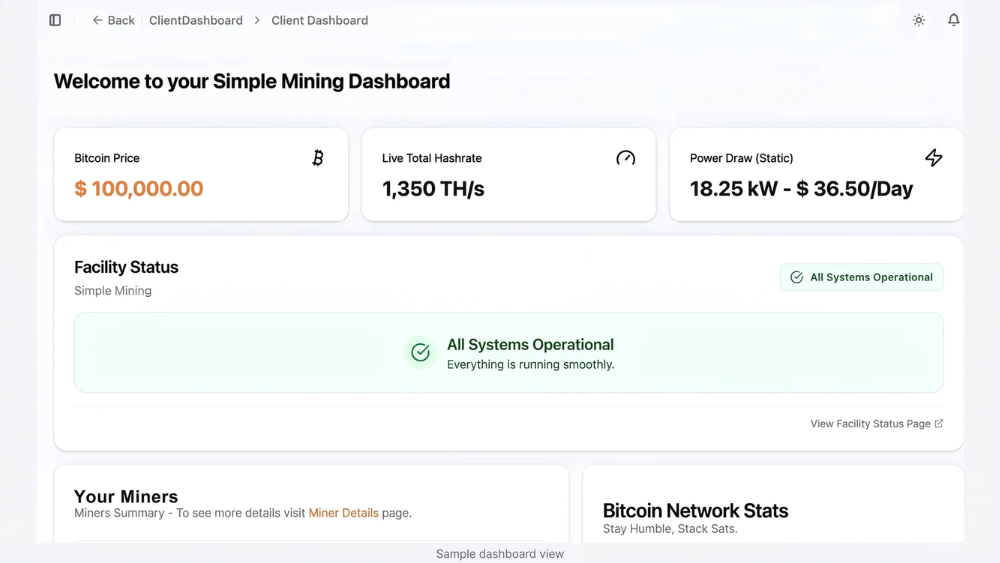
Hosted Bitcoin mining clients benefit most from pool mining for three reasons. First, daily pool payouts align with monthly hosting billing cycles, so income covers operating costs in real time. Second, hosted dashboards monitor pool performance alongside hashrate and uptime, giving operators a single view of the operation. Third, hosting providers handle pool configuration and stratum routing, removing the technical setup that makes solo mining viable only for full-time operators.
Simple Mining clients connect to any pool of their choice, with discounted pool fees available through partnerships with Luxor, NiceHash, and Ocean. To see which machines fit your strategy, buy a Bitcoin miner tuned for hosted pool mining from day one.
FAQs
Do solo miners ever win blocks?
Yes. Solo miners do find blocks, but the events are rare enough to make headlines when they happen. A small operator finding a block solo is statistical luck, not a repeatable strategy.
How much hashrate do I need to solo mine Bitcoin profitably?
You need around 9.5 EH/s of hashrate to find a block on average every 16 to 17 hours. That works out to 1% of total network hashrate at 941.88 EH/s, or about 34,900 Antminer S21 XP-class miners running at full capacity. Below that scale, solo mining is statistical gambling rather than income.
Can I switch from pool mining to solo mining later?
Yes. The switch is a configuration change in your mining software and stratum settings. No new hardware is required, and you can switch back at any time.
What happens to my rewards if a mining pool shuts down?
Unpaid balances may be lost if a pool shuts down without notice. Most established pools pay out on schedule and post advance notice of any service changes. The risk argues for choosing pools with strong track records, like the ones covered in our best Bitcoin mining pools for 2026.
Why Pool Mining Wins for Most Miners in 2026
Pool mining is the rational choice for most Bitcoin miners in 2026. It delivers predictable daily payouts, works at any hashrate scale, and removes the variance that makes solo mining unviable below industrial scale. Pool fees of 1% to 2.5% are a small price for converting a 1-in-66-year lottery into steady daily income.
Operational success in Bitcoin mining depends on uptime, cost discipline, and predictable revenue. Solo mining fails on the third leg for everyone below industrial scale. Pool mining clears all three.
Solo mining sells you a lottery ticket. Pool mining sells you a paycheck.
Start hosted, pool-connected mining with a 7-day free trial from Simple Mining and see your hashrate live in under a week.